What Counts as a Switchblade
Under the Federal Switchblade Act of 1958, a switchblade is a knife whose blade opens automatically when you press a button or other device in the handle, or through inertia or gravity. The knife industry calls the same thing an automatic knife, or an auto. In the UK and Australia it is a flick knife. All three names describe one mechanism: a spring does the opening, and you only release it.
Two things are often mistaken for switchblades and are not. Assisted-opening knives need you to start the blade moving before a spring takes over. Manual folders with a thumb stud, hole or flipper have no spring at all. Section 05 shows how to tell them apart in a few seconds.
Side-Opening Automatics
This is the original switchblade and still the most common type. The blade pivots out of the side of the handle, exactly like a folding knife, but a spring inside the handle does the swinging. With the blade closed, the spring is under tension. Press the button and the blade snaps open and locks. To close it, press the same button to release the lock and fold the blade by hand, which loads the spring for the next opening.
Because the blade rides on a pivot and locks the way a quality folder does, a side-opener has the strongest lockup of any automatic and no blade play. The blade can be as thick and as broad as a folder's, so it slices and stands up to hard cutting better than most OTFs of the same size. The trade-off is that the spring sits loaded in your pocket. A good side-opener has a safety switch that blocks the button until you want it, which is why the A3 Delta and A3 Delta Mini carry one. Nearly all side-openers are single action: the spring opens, you close.
Out-the-Front Automatics
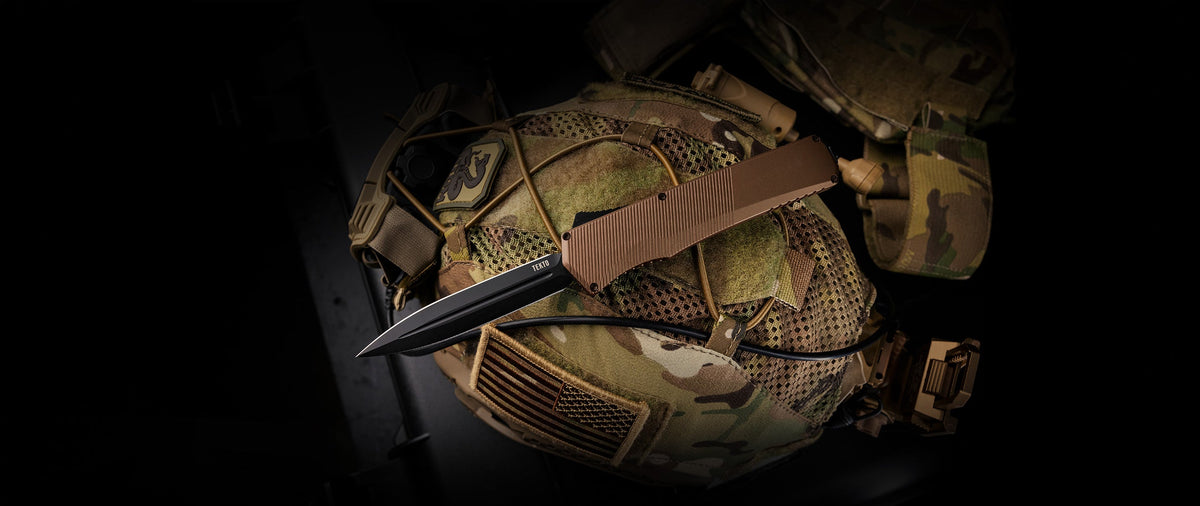
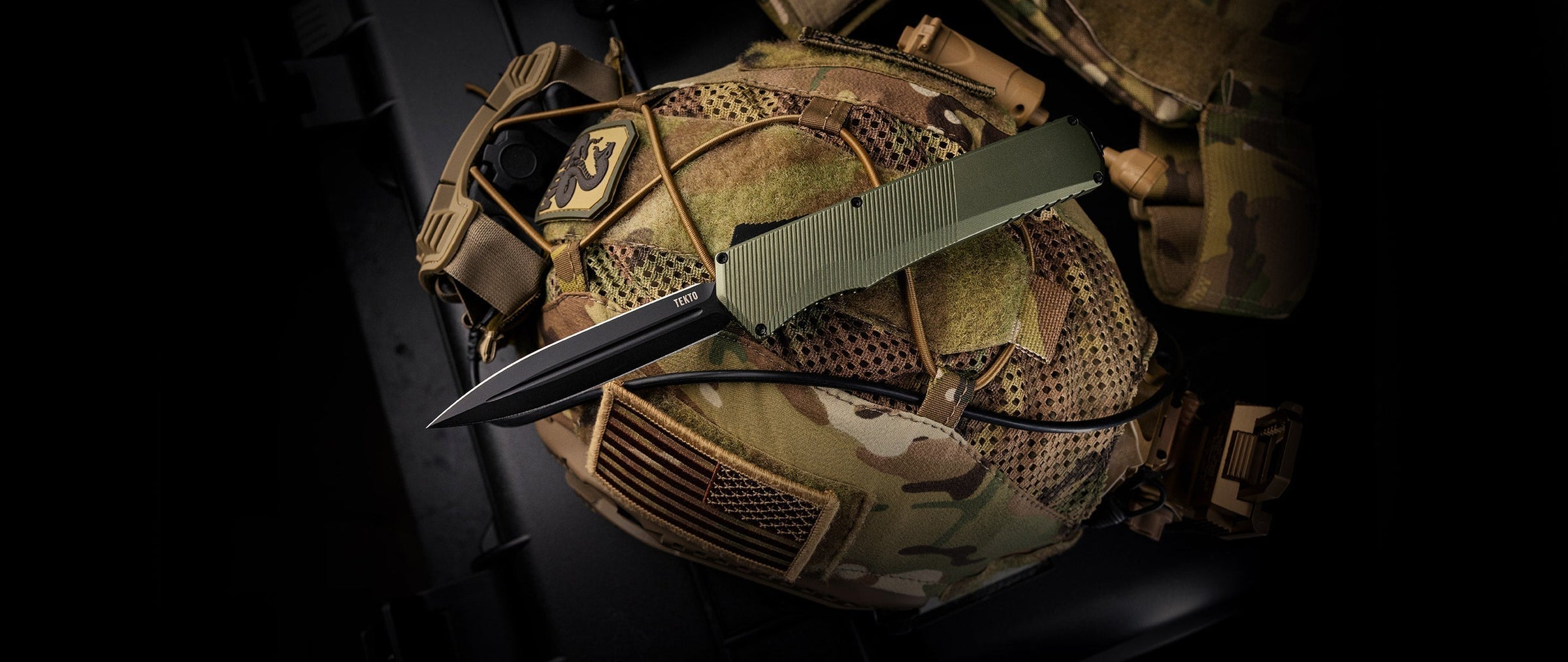
An OTF blade does not swing. It travels straight out of the front of the handle on a track and straight back in. You work it with a thumb slider on the face of the handle, which makes it the easiest automatic to use with either hand. OTFs come in two kinds, and the difference matters more than it sounds.
Double action is what almost every OTF sold today uses. Push the slider forward and the blade fires out and locks. Pull the same slider back and it retracts. At rest the spring is relaxed. You load it each time you move the slider, right up to the point where it lets go. Double-action OTFs also have a built-in reset. If the blade meets resistance on the way out, it stops short instead of forcing through, and you pull it the rest of the way by hand to re-engage the mechanism. The A2 Badger, A5 Spry and A7 Zastava are all double action.
Single action OTFs fire the blade with a button and leave the retracting to you, usually with a charging handle or by pulling the blade back into the handle. The spring is loaded while the knife is closed, so single-action OTFs tend to deploy harder and faster. They are rarer now and mostly bought by collectors.
OTFs carry slim and symmetrical, and you never touch the blade to open or close them. The costs are a small amount of side-to-side blade play, which is normal for the design, a track that collects pocket lint, and a blade that is thinner than a folder's. For a closer look at the mechanism, read OTF Knives Explained.
Stilettos and Other Classic Patterns
The Italian stiletto is the knife most people picture when they hear the word switchblade: a long, slim handle, a narrow bayonet or dagger blade, and a push button near the bolster. Mechanically it is a side-opening automatic. What sets it apart is the closing. On a traditional pick-lock stiletto you lift a small lever on the bolster to unlock the blade. On a swivel-bolster stiletto you twist the bolster. A leverletto is the same knife with a lever in the bolster doing the firing instead of a button. These patterns are bought for their history and looks more than for daily cutting.
Two other side-opening patterns are worth knowing. Lever-lock automatics, a German design, use a lever on the handle that unlocks and fires the blade in one motion. Scale-release automatics, sometimes called hidden-release, have no visible button: you press part of the handle scale itself. They look like plain folders, which is the point, but legally they are still switchblades.
Automatic, Assisted or Manual: How to Tell
Pick up the closed knife and ask one question: does the blade move before you touch it? If a button, slider or lever on the handle starts the blade from fully closed, it is an automatic. If you have to push a thumb stud or pull a flipper tab to start the blade and a spring finishes the job, it is assisted. If nothing helps, it is manual.
The distinction matters because assisted openers are not switchblades under federal law. Congress amended the Federal Switchblade Act in 2009 to say so, and most states follow that line, though a few cities and states still treat them with suspicion. Gravity knives and balisongs are separate categories again, with their own rules, and this guide does not cover them.
Side by Side
| Type | How it opens | How it closes | Blade you usually see | Carry | Best for |
|---|---|---|---|---|---|
| Side-opening, single action | Button in the handle | By hand, which reloads the spring | Drop point, clip point, tanto | Like a normal folder | Daily use and hard cutting |
| OTF, double action | Thumb slider forward | Same slider back | Dagger, spear point, tanto | Slim and symmetrical, either hand | One-hand open and close |
| OTF, single action | Button | Charging handle, or pull the blade back | Dagger | Slim | Speed and collecting |
| Stiletto and leverletto | Button or bolster lever | Pick lock or swivel bolster | Long bayonet or dagger | Long and slim | Tradition and collecting |
| Scale release | Press the handle scale | By hand | Drop point | Looks like a plain folder | Low profile |
| Assisted (not a switchblade) | You start it, a spring finishes | By hand | Any | Like a folder | Where automatics are restricted |
Which Type Should You Carry
Start with blade length, because the law often decides it for you. California treats automatics with blades under 2 inches differently from longer ones, and several other states draw their own lines. That is what the A3 Delta Mini at 1.90 inches and the A2 Badger at 1.85 inches are for. Our guide to blade length covers the trade-offs.
Then choose by how you cut. If you lean on a knife, open boxes all day or want a blade with a folder's thickness and lockup, a side-opener such as the A3 Delta is the better tool. If you want to open and close with one hand and never touch the blade, want a knife that works the same in either hand, or carry it in a tight pocket, a double-action OTF such as the A5 Spry suits you better.
After that, look at the details that make a difference every day: a safety switch on a side-opener, a reversible pocket clip, and a blade steel that holds an edge without being hard to sharpen. D2 at 58 to 62 HRC and S35VN are both good choices in this price range. Whatever you pick, read our care guide once. Automatics live longer when the track and pivot are kept clean.
Where Switchblades Came From
Spring-opening knives go back to the 1800s, but the modern switchblade dates to 1892, when George Schrade patented a push-button knife and began making them in New York. Schrade's Presto autos were sold as work knives for decades. Italian stilettos arrived in large numbers after the Second World War, brought home by soldiers and then imported by the hundreds of thousands. The 1950s turned the knife into a symbol. Newspapers and films, Rebel Without a Cause among them, tied it to juvenile delinquency, and in 1958 Congress passed the Federal Switchblade Act. The law restricts importing switchblades and shipping them across state lines. It has never banned owning one.
Are Switchblades Legal to Own and Carry
Whether you can own, buy or carry a switchblade is decided by state and local law, and the trend over the last fifteen years has run toward legalization. Texas removed its switchblade ban in 2013. Massachusetts' highest court struck the state's ban down in 2024. Most states now allow ownership, and the common restrictions that remain are on blade length, concealed carry, or carry in specific places such as schools and courthouses. A handful of states and cities still prohibit them outright.
The federal law adds two things worth knowing. Automatics can be shipped to you only in states that allow them, which is why retailers ask for your address before they sell. And the Act exempts people with the use of only one arm, which is where many of the first legal carve-outs came from.
Before you buy, check your state in our 50-state guide to automatic knife laws. It links to our detailed pages for California, Texas, Florida and Massachusetts, among others, and we update it as laws change.
Knives in This Guide
One of each type the guide explains: two side-openers and two double-action OTFs, with a compact and a full-size of each.
-
-

OUT OF STOCK
 Sold out
A3 Delta Mini
Regular price $139.99Regular priceUnit price per -
-


People Are Asking
What is the difference between a switchblade and an automatic knife?
Nothing. Switchblade is the legal and everyday word, automatic knife is the industry's. Both mean a knife whose blade opens by itself when you press a button or move a switch.
Is an OTF knife a switchblade?
Yes. An OTF is an automatic knife whose blade travels straight out of the handle instead of swinging out of the side. Any law that applies to switchblades applies to OTFs.
Are assisted-opening knives switchblades?
Not under federal law. An assisted opener needs you to start the blade moving before its spring finishes the job, and the Federal Switchblade Act was amended in 2009 to exclude them. A few states and cities still restrict them, so check locally.
Why did switchblades become illegal?
In the 1950s newspapers and films tied the switchblade to juvenile delinquency, and in 1958 Congress passed the Federal Switchblade Act. The Act restricts importing and shipping switchblades across state lines. It never banned owning one. The ownership and carry bans came from individual states, and many have since repealed them.
Are switchblades legal in the United States?
Owning one is legal in most states, and the trend since 2010 has run toward legalization. Restrictions that remain are usually on blade length, concealed carry or carry in certain places. Check your state in our 50-state guide before you buy.
What is a double-action OTF?
An OTF whose single thumb slider both extends and retracts the blade. The spring is relaxed at rest and loads as you move the slider. Almost every OTF sold today is double action.
What is the difference between a stiletto and a switchblade?
A stiletto is one style of switchblade: a long, slim side-opening automatic with a narrow blade, in the Italian pattern. Every stiletto of this kind is a switchblade, but most switchblades are not stilettos.
Who invented the switchblade?
Spring-opening knives existed in the 1800s, but the push-button automatic as we know it was patented by George Schrade in 1892. His company sold them as work knives for decades before the 1950s made them notorious.