The Short Version
If you are left-handed and want an automatic knife, buy an out-the-front. A side-opening automatic fires from a button set on one face of the handle, near the pivot, where a right thumb lands. In a left hand that button is on the wrong side, and the fix is a mirrored left-hand model that only a few makers build. An OTF has no wrong side. Its slide sits on the centerline of the handle face and the blade travels straight out the front, so a left thumb works it exactly as a right thumb does, from either pocket, with the clip where it already is. Every TEKTO OTF, the A5 Spry, A5 Spry Mini, A7 Zastava, A2 Badger and A4, is left-hand ready out of the box. The rest of this guide explains why, what to check on any automatic before you buy it, and how our side-opener and manual folders behave in the left hand.
Why Most Knives Are Built for the Right Hand
About one person in ten is left-handed, and knife makers design for the other nine. The bias shows up in four places. The lock: a liner lock or frame lock is cut into the scale that faces a right-hander's thumb, so a right hand closes the knife with the thumb and a left hand has to reach across with the index finger. The opener: thumb studs are often fitted on one side only, and a side-opening automatic's button is placed where a right thumb falls. The clip: many folders drill the handle for a clip on one side, tip-up or tip-down, so the knife rides correctly in a right pocket and upside down or backward in a left one. And the grind: a few traditional and kitchen knives are ground on one side only, which steers a cut toward or away from the hand holding them. Modern pocket knives are mostly flat or V-ground, so that last one rarely matters. The first three decide whether a knife is pleasant or annoying for a lefty.
What to Check on Any Automatic
Four questions settle whether an automatic is left-hand friendly. Where is the firing control, and does a left thumb reach it without regripping? A button on the face near the pivot is a right-hand control. A slide or button on the centerline of the face is ambidextrous. Which hand closes it? On an OTF the slide retracts the blade, so the answer is the same hand that opened it. On a side-opener the button both fires and releases, so closing is also one-handed, but the blade swings down past the fingers of the hand holding it, which is worth practicing slowly in the left hand. Is there a safety, and can a left thumb reach it? Some side-openers put a safety slider beside the button. Check that it falls under the left thumb or the left index finger. And can the clip go on the other side, or does the design make it irrelevant? A clip on the back face of an OTF handle, centered, carries the same in either pocket. A clip mounted on one scale of a folder needs a second set of holes to move.
Why OTF Knives Are the Left-Handed Automatic
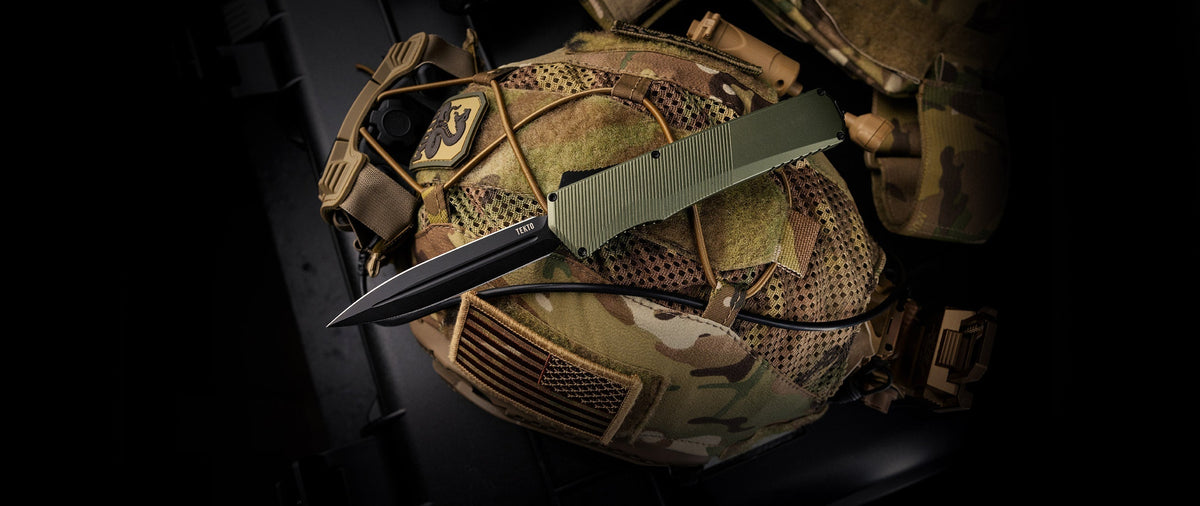
An out-the-front automatic is symmetrical in every way that matters to the hand. The handle is a flat rectangle with the blade channel down the middle. The slide is mounted on one face, centered left to right, and it moves along the handle's long axis, forward to fire and back to retract. Pick the knife up in either hand with that face toward your thumb and the slide is in the same place relative to your grip. The blade does not swing out of one side of the handle, so there is no "show side" and no side the edge favors on the way out. The clip is on the opposite face, also centered, so in a left pocket the knife sits with the clip out and the slide against the leg, which is exactly how it sits in a right pocket. A left hand reaching into a left pocket closes around the back of the handle with the thumb landing on the slide face, the mirror image of a right hand doing the same thing on the right side. Nothing has to be reversed, swapped or relearned.
That is why no maker sells a "left-handed OTF": there is nothing to mirror. It is also why the picks below are led by them.
Side-Opening Automatics in the Left Hand
A side-opening automatic like our A3 Delta fires from a button on the face of the handle near the pivot, and the blade swings out of the top of the handle on the far side from the button. Held in the right hand, the button is under the thumb. Held in the left hand, the same face is against the fingers, and the button falls under the index or middle finger instead. It still fires: a fingertip press works as well as a thumb press, and many right-handers fire side-openers that way too. The Delta's safety switch is worked the same way, with whichever fingertip is nearest. What changes is the feel, not the function, and a day of carrying it settles the new grip. If you want the button under your thumb with no adjustment, that is the one thing the A3 Delta cannot give a left hand, and it is the reason this guide points lefties to the OTFs first. The Delta's pocket clip is ambidextrous, so carry is not the problem. The thumb is.
Manual Folders for the Left Hand
Manual flippers are the most left-hand friendly folders there are, because the flipper tab is part of the blade and sits on the centerline: a left index finger pulls it exactly as a right one does. The lock is where handedness creeps back in. Our F1 Alpha and F2 Bravo use liner locks, which a right thumb pushes aside to close and a left index finger pushes instead, a motion that takes a day to learn and then stops being a thought. The F3 Charlie and F4 Echo use button locks, which release with a press from whichever finger is nearest, and are the easier of the two for a lefty. On clips, the F1 Alpha ships with an ambidextrous clip. The F2 Bravo, F3 Charlie and F4 Echo carry a single-position clip, so a left-handed carrier of those rides them in the left pocket with the clip on the inside or carries them loose. If a clip on the correct side matters to you, the F1 Alpha is the manual to pick.
Pocket Clips, Tip-Up and the Left Pocket
"Ambidextrous clip" means the handle is drilled so the clip can be moved to the other side, or the clip is mounted on a centered face so it does not need to move. Tip-up or tip-down describes which end of the knife points to the sky when it is clipped in. On an OTF none of this requires a screwdriver: the clip is centered on the back face and the knife rides the same in either pocket, with the blade end up so the slide is under your thumb on the draw. On a folder with a reversible clip, move it to the side that puts the clip on the outside of your left pocket and the opening side of the blade where your thumb or finger lands. On a folder with a fixed clip, the knife will ride with the clip inside the left pocket, which is less secure and slower to draw. It works, and plenty of lefties live with it, but it is a reason to prefer the knives whose clips move.
The TEKTO Picks for Left-Handed Carry
The lineup, in the order we would suggest it to a left-handed customer.
| Knife | Type | In the left hand | Clip |
|---|---|---|---|
| A5 Spry (3.50 in, S35VN or MagnaCut) | OTF automatic | Identical to the right hand: centered slide, straight-out blade | Ambidextrous, centered |
| A5 Spry Mini (1.85 in, S35VN) | OTF automatic | Identical to the right hand. The under-2-inch choice where blade length is regulated | Ambidextrous, centered |
| A7 Zastava (3.60 in, S35VN) | OTF automatic | Identical to the right hand | Ambidextrous, centered |
| A2 Badger (1.85 in, D2) | OTF automatic | Identical to the right hand. The smallest and lightest | Ambidextrous, centered |
| A4 (3.80 in, D2, serrated double edge) | OTF automatic | Identical to the right hand | Single position, centered on the face |
| A3 Delta (3.60 in) and A3 Delta Mini (1.90 in) | Side-opening automatic | Fires from the index finger instead of the thumb. Safety switch worked with a fingertip | Ambidextrous |
| F1 Alpha (3.10 in, D2) | Manual flipper, liner lock | Flipper is centered. The lock releases with the index finger | Ambidextrous |
| F3 Charlie (3.80 in) and F4 Echo (3.40 in) | Manual flipper, button lock | Flipper is centered. The button lock releases from either side | Single position |
| F2 Bravo (3.30 in, D2) | Manual flipper, liner lock | Flipper is centered. The lock releases with the index finger | Single position |
| X1 Atlas (3.30 in, MagnaCut) | Fixed blade | No handedness. A fixed blade is the same knife in either hand | Kydex sheath with an adjustable belt clip |
If you want one recommendation: the A5 Spry in the blade shape you prefer, Drop Point for everyday cutting, Tanto for a reinforced point, Double Edge where your state allows it. If you want the smallest, the A2 Badger. If you want a folder with a clip on your side, the F1 Alpha.
Check Your State Before You Buy an Automatic
Handedness does not change the law, and automatic knives are still restricted in a few states. Washington bans possession of any spring blade knife, OTFs included. California caps automatics at a 2-inch blade, which is why the A2 Badger and A5 Spry Mini exist. Illinois requires a FOID card. Several states draw lines around concealed carry or double-edged blades. Our 50-state OTF law guide has the summary and our state pages have the statutes. Read yours before the knife ships.
Left-Hand Ready
Three OTFs that work the same in either hand, and the manual folder with a clip that moves to your side.


People Are Asking
Is there a knife for left-handed people?
Yes, two kinds. A few makers build mirrored left-hand versions of their side-opening automatics and folders. The simpler answer is a knife with no handedness at all: an OTF automatic, whose centered slide and straight-out blade work the same in either hand, or a manual flipper with an ambidextrous clip.
What are the best knives for left-handed people?
For an automatic, an OTF, because nothing on it is placed for one hand. For a manual folder, a flipper with a button lock or an ambidextrous clip, since the flipper tab is centered and the lock is the only part that favors a side. For a fixed blade, any of them. A fixed blade has no handedness.
Do OTF knives come in left-handed versions?
No, because they do not need to. The slide is on the centerline of the handle face and the clip is centered on the back, so a left thumb and a left pocket get the same knife a right thumb and a right pocket do.
Can a left-handed person use a side-opening automatic?
Yes. The button sits on one face near the pivot, so in the left hand it falls under the index finger instead of the thumb. It fires the same. The grip takes a day to get used to. The A3 Delta works this way and its clip is ambidextrous.
Can a left-handed person use a liner lock knife?
Yes. The lock bar is on the side a right thumb reaches, so a left hand closes the knife by pushing the liner with the index finger instead. The F1 Alpha and F2 Bravo use liner locks. The F3 Charlie and F4 Echo use button locks, which release from either side.
Which TEKTO knives have an ambidextrous pocket clip?
The A5 Spry, A5 Spry Mini, A7 Zastava, A2 Badger, A3 Delta, A3 Delta Mini and F1 Alpha. The A4, F2 Bravo, F3 Charlie and F4 Echo carry a single-position clip. The X1 Atlas rides in a Kydex sheath with an adjustable belt clip.
Are automatic knives illegal in the US?
Not federally for ownership. The federal Switchblade Act restricts interstate shipping and sale, not possession, and most states now allow automatics. A few do not (Washington bans them) and some set a blade limit (California, 2 inches). Our 50-state OTF law guide has the list.
What does ambidextrous mean on a knife?
That the knife can be opened, closed and carried by either hand without modification: the opener is reachable from both sides, the lock can be released by either hand, and the clip can be moved to either side or is centered so it does not need to be.