The Short Version
Ohio has no permit for knives, no blade length limit, one banned knife and, since 2021, no difference between a knife in a pocket and a knife on a belt. The carrying concealed weapons statute, R.C. 2923.12, still forbids carrying a concealed "deadly weapon," but division (H), added by Senate Bill 140, says that for this section "deadly weapon" or "weapon" "does not include any knife, razor, or cutting instrument if the instrument was not used as a weapon." The same bill struck switchblades, springblades and gravity knives from the list of things no one may make or sell. A year later the state added knives to its preemption statute, R.C. 9.68, which voids every city and county knife ordinance in Ohio. What is left: do not carry a knife as a weapon, and keep every knife out of a school and a courthouse.
What Changed in 2021
Before April 12, 2021, Ohio knife law was two things. R.C. 2923.20 made it a crime to "manufacture, possess for sale, sell, or furnish to any person other than a law enforcement agency ... any brass knuckles, cestus, billy, blackjack, sandbag, switchblade knife, springblade knife, gravity knife, or similar weapon," which left automatics legal to own but impossible to buy in the state. And 2923.12 made it a first-degree misdemeanor to carry any concealed deadly weapon, with a deadly weapon defined in 2923.11(A) as "any instrument, device, or thing capable of inflicting death, and designed or specially adapted for use as a weapon, or possessed, carried, or used as a weapon." Under that definition a dagger was a deadly weapon by design and a pocketknife became one the moment a prosecutor could argue you carried it for defense, which produced years of arrests over folders in pockets.
Senate Bill 140, signed in January 2021 and effective April 12, did two things. It deleted the knife language from 2923.20 entirely, so the sale ban is gone. And it added division (H) to 2923.12: "For purposes of this section, 'deadly weapon' or 'weapon' does not include any knife, razor, or cutting instrument if the instrument was not used as a weapon." The test is no longer what the knife is or why you carry it. It is whether you used it as a weapon. A dagger in a pocket is not a weapon. A box cutter pulled in an argument is.
The One Test: Used as a Weapon
Everything in Ohio knife law now turns on the phrase "used as a weapon," and the statute does not define it. On its face it means what it says: a knife that cut rope, opened boxes or sat in a pocket was not used as a weapon. A knife drawn, brandished, pointed or employed against a person was. The affirmative defenses in 2923.12(D), written for other weapons, still exist for a knife that was used as one: that you carried it for defense while engaged in a lawful occupation that left you "particularly susceptible to criminal attack," that you had "reasonable cause to fear a criminal attack," or that you were in your own home. Those defenses cover the person who used a knife to stop an assault. They are not needed by the person who never drew it.
Where the old cases still matter is the other weapons statutes, which use the 2923.11 definition without division (H). In a school safety zone or a courthouse, a knife "designed or specially adapted for use as a weapon" or "possessed, carried, or used as a weapon" is a deadly weapon, so a knife made only for fighting is a weapon by design, and an ordinary pocketknife is one only if you carry it as one. That is the line to keep in mind at the two places where it is still drawn.
What You Can Carry
Everything. Folding knives of any length, fixed blades, hunting knives, daggers, dirks, stilettos, double-edged blades, bowies, machetes, swords, butterfly knives, gravity knives, assisted openers, side-opening automatics and OTF automatics are all legal to buy, own and carry in Ohio, openly or concealed, on your person or in your vehicle, in every city, with no permit and no length rule. Ohio has no statute on knives in vehicles, no knife rule for parks and, apart from the ballistic knife, no banned knife. Out-of-state visitors are covered by the same statute as residents.
What You Cannot Own
One knife. R.C. 2923.11(J) defines a "ballistic knife" as "a knife with a detachable blade that is propelled by a spring-operated mechanism," and division (K)(1) lists it as "dangerous ordnance" alongside automatic and sawed-off firearms. Under 2923.17, knowingly acquiring, having, carrying or using dangerous ordnance is a fifth-degree felony, and for a person under a weapons disability it is a third-degree felony under 2923.13. Federal law separately bans shipping one across state lines. Nothing else is on the list: no other knife is named anywhere in the dangerous ordnance definition or the Revised Code.
Brass knuckles are the other thing people ask about. Senate Bill 140 struck them from the sale ban along with the switchblades, so they are legal to make, sell and own. But the 2021 carve-out in 2923.12(H) covers "any knife, razor, or cutting instrument," not knuckles, and knuckles have no use except as a weapon, which puts them inside the 2923.11 definition of an instrument "designed or specially adapted for use as a weapon." Carrying them concealed is still carrying a concealed weapon until a court says otherwise.
Local Ordinances Are Void
Ohio is one of the few states where a city cannot write its own knife rule. R.C. 9.68 declares that "a person, without further license, permission, restriction, delay, or process, including by any ordinance, rule, regulation, resolution, practice, or other action ... may own, possess, purchase, acquire, transport, store, carry, sell, transfer, manufacture, or keep ... any knife," defines a knife as "a cutting instrument" including "a sharpened or pointed blade," says expressly that carrying includes carrying "openly or concealed on a person's person or concealed ready at hand," and "preempts, supersedes, and declares null and void" any local rule to the contrary. Knives were added to the section by Senate Bill 156, effective September 13, 2022, and the section was amended again by Senate Bill 58, effective April 9, 2025. Division (B) lets anyone adversely affected by a local knife ordinance sue the city for damages, an injunction and attorney's fees, and awards the fees even if the city repeals the ordinance after the suit is filed.
Some Ohio city codes still print the old blade-length and concealed-knife rules they adopted decades ago. They cannot be enforced. If an officer cites you under one, the ordinance is void on its face and the citation is the city's problem, not yours.
Where You Cannot Carry
- School safety zonesNo deadly weapon in a school, on school premises, at a school activity or on a school bus. A knife is a deadly weapon here under the ordinary definition, so one designed as a weapon, or carried as one, is a fifth-degree felony. An ordinary pocketknife carried as a tool does not fit the definition, but every school district's code of conduct bans it anyway, and a student with one is expelled. Keep every knife out of a school.2923.122
- CourthousesNo deadly weapon in a courthouse or any building with a courtroom in it, conveyed or possessed: a fifth-degree felony, fourth on a repeat. The same deadly weapon definition applies, and courthouse security screens for every knife at the door, so the practical rule is that nothing goes in.2923.123
- AirportsNo knives past the checkpoint under federal rules, and carrying a concealed weapon aboard an aircraft is a third-degree felony under 2923.12.TSA
- Private propertyEmployers, venues and property owners set their own policy. Preemption binds governments, not landlords. Breaking a posted rule gets you removed, and refusing to leave becomes trespass.Posted rules
Minors and Felons
Ohio sets no minimum age for owning or carrying a knife, and no statute restricts selling one to a minor. The furnishing statutes are written for firearms. Schools are where a teenager's knife becomes a problem, and the school safety zone statute suspends the driver's license of an offender under 19. For a person with a felony conviction, R.C. 2923.13, having weapons while under disability, covers firearms and dangerous ordnance only, so for every knife but the ballistic knife (which is dangerous ordnance, and a third-degree felony under disability) the rules are the same as for anyone else: carry it as a tool, not as a weapon. Probation and parole terms often say otherwise, and those control.
Penalties
| Offense | Section | Penalty |
|---|---|---|
| Carrying a concealed knife that was used as a weapon | 2923.12(A)(1) | First-degree misdemeanor: up to 180 days, up to $1,000. Fourth-degree felony with a prior weapons or violence conviction |
| The same aboard an aircraft, or with purpose to board one | 2923.12(F)(1) | Third-degree felony: 9 to 36 months |
| Carrying or possessing a knife as a deadly weapon in a school safety zone | 2923.122(A), (B) | Fifth-degree felony: 6 to 12 months, up to $2,500. Fourth-degree on a repeat. License suspension if under 19 |
| Conveying or possessing a knife as a deadly weapon in a courthouse | 2923.123(A), (B) | Fifth-degree felony: 6 to 12 months, up to $2,500. Fourth-degree on a repeat |
| Carrying brass knuckles concealed | 2923.12(A)(1) | First-degree misdemeanor: up to 180 days, up to $1,000 |
| Acquiring, having or carrying a ballistic knife | 2923.17(A) | Fifth-degree felony: 6 to 12 months, up to $2,500 |
| A ballistic knife while under a weapons disability | 2923.13 | Third-degree felony: 9 to 36 months |
| A city enforcing its own knife ordinance | 9.68(B) | The ordinance is void. The city pays damages and attorney's fees |
What the Internet Gets Wrong
Four things, most of them written before 2021 and never updated. First, that switchblades are illegal in Ohio: the sale ban was repealed by Senate Bill 140, effective April 12, 2021, and possession was never banned. Second, that a concealed knife is a concealed weapon: not since division (H), unless it was used as one. Third, that Cleveland, Columbus, Akron or another city has a blade length limit or a concealed-knife rule that still applies: every local knife ordinance in Ohio has been void since September 13, 2022, and the city can be sued for enforcing one. Fourth, that there is a legal knife length in Ohio: there has never been one in state law, and the city numbers people remember are the void ordinances.
TEKTO Knives for Ohio
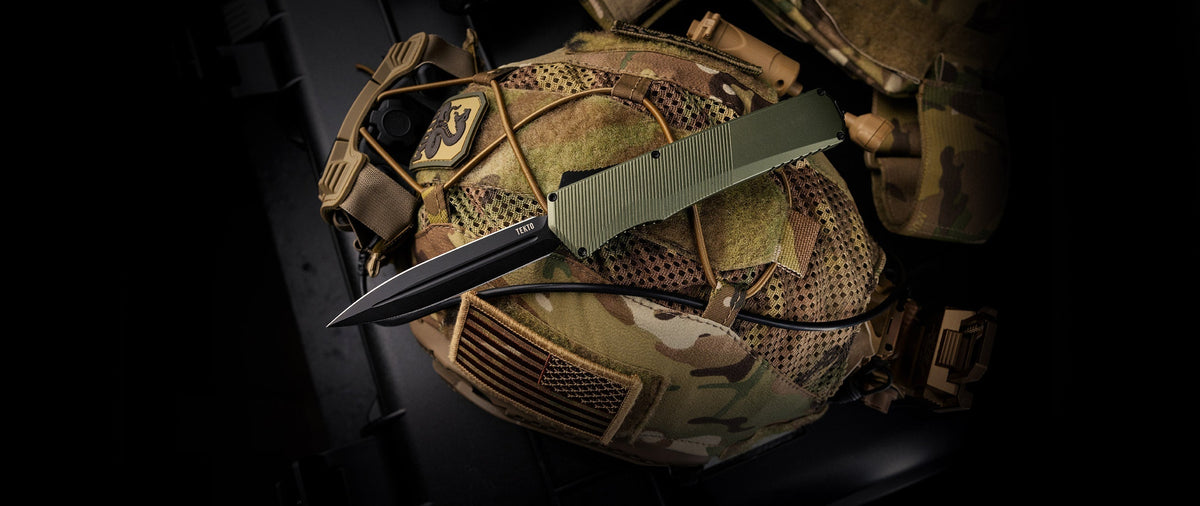
Every TEKTO knife is legal to buy, own and carry anywhere in Ohio, so the choice is about the knife. The OTFs, the A5 Spry, A5 Spry Mini, A2 Badger, A7 Zastava and A4, are legal in Double Edge as well as Drop Point and Tanto, and legal in the pocket, because the state no longer asks what a concealed knife is, only how it was used. The A3 Delta side-opener, the F1 Alpha, F2 Bravo, F3 Charlie and F4 Echo manual flippers and the X1 Atlas fixed blade are in the same position. Two habits are worth keeping: nothing goes into a school or a courthouse, and if you ever have to use a knife to defend yourself, the (D) defenses in 2923.12 are written for exactly that, so talk to a lawyer before you talk to anyone else.
TEKTO Knives for Ohio
All of them, open or concealed. Four to start with.


People Are Asking
Are switchblades illegal in Ohio?
No. Senate Bill 140, effective April 12, 2021, repealed the ban on manufacturing and selling switchblades, springblades and gravity knives in R.C. 2923.20, and owning one was never illegal. They are legal to buy, own and carry, openly or concealed.
Are OTF knives legal in Ohio?
Yes. An OTF is an automatic knife, and the same 2021 change covers it. It can be carried in a pocket, because under 2923.12(H) a knife is not a concealed weapon unless it is used as one.
What is the legal knife length in Ohio?
There is none. No section of the Revised Code sets a blade length, and the city limits people remember, such as the old 2.5-inch rules, were voided when R.C. 9.68 began covering knives on September 13, 2022.
Can you conceal carry a knife in Ohio?
Yes, any knife, since April 12, 2021. R.C. 2923.12(H) says a knife, razor or cutting instrument is not a deadly weapon for the concealed carry statute "if the instrument was not used as a weapon." Use one as a weapon and the concealed carry charge, a first-degree misdemeanor, comes back.
Are butterfly knives illegal in Ohio?
No. A balisong is not named anywhere in the Revised Code. It is legal to own and carry, openly or concealed, under the same used-as-a-weapon rule as every other knife.
Are brass knuckles illegal in Ohio?
Legal to buy and own since the 2021 repeal of the sale ban, but treat carrying them concealed as a first-degree misdemeanor: the 2021 exclusion in 2923.12(H) covers knives, razors and cutting instruments, not knuckles, and knuckles fit the 2923.11 definition of an instrument designed for use as a weapon.
Are ballistic knives legal in Ohio?
No. A knife with a detachable blade propelled by a spring is "dangerous ordnance" under 2923.11(J) and (K)(1), and knowingly acquiring, having or carrying one is a fifth-degree felony under 2923.17. It is the only knife Ohio bans.
Can a felon carry a knife in Ohio?
The weapons-under-disability statute, R.C. 2923.13, covers firearms and dangerous ordnance, which among knives means only the ballistic knife. For every other knife a person with a felony conviction follows the same rules as anyone else, subject to any probation or parole conditions.
Can a city in Ohio ban knives?
No. R.C. 9.68 preempts every local ordinance on owning, carrying, selling or transporting a knife, openly or concealed, and lets a person affected by one sue the city for damages and attorney's fees. Ordinances still printed in city codes cannot be enforced.
Can I take a knife to school or a courthouse in Ohio?
No. A knife carried as a weapon in a school safety zone or a courthouse is a fifth-degree felony under 2923.122 and 2923.123, every school bans knives by its own rules, and courthouse security screens for them at the door. Leave it in the car.
Sources
- R.C. 2923.12 Carrying concealed weapons: the offense in (A), the affirmative defenses in (D), penalties in (F), the knife exclusion in (H) added by Senate Bill 140
- R.C. 2923.11 Definitions: "deadly weapon" in (A), "ballistic knife" in (J), "dangerous ordnance" in (K)
- R.C. 2923.20 Unlawful transactions in weapons, as amended by Senate Bill 140 effective April 12, 2021, with the switchblade, springblade and gravity knife language removed
- R.C. 9.68 Regulation of arms prohibited: knives added by Senate Bill 156 effective September 13, 2022, amended by Senate Bill 58 effective April 9, 2025
- R.C. 2923.122 Deadly weapons in a school safety zone
- R.C. 2923.123 Deadly weapons in a courthouse
- R.C. 2923.13 Having weapons while under disability
- R.C. 2923.17 Unlawful possession of dangerous ordnance
- AKTI Ohio knife law summary, American Knife and Tool Institute
Checked against the Ohio Revised Code on October 11, 2026. This page summarizes the law for general information and is not legal advice. Laws change and enforcement varies by officer, prosecutor and judge; for your own situation, talk to an Ohio attorney.
How these pages are researched: our method, sources and what we will not claim. Pending cases and recent changes are tracked on Knife Law Watch.