The Short Version
Spring-fired knives by the late 1700s. George Schrade's push-button patent in 1892 and the Presto that followed. The U.S. Army M2 paratrooper knife, approved December 1940. Italian stilettos in GI duffel bags after 1945. "The Toy That Kills" in 1950, New York's ban in 1954, the Federal Switchblade Act on August 12, 1958. Assisted openers exempted in 2009. State repeals from 2010 onward, more than twenty so far.
Three things about the switchblade are true at once. It is a very old idea, older than the United States. For most of its life it was sold as a working tool, to farmers, sailors, soldiers and anyone with one hand busy. And for about sixty years, from 1958 until the repeals of the 2010s, it was the one kind of pocketknife most Americans could not legally buy, because of a moral panic that had almost nothing to do with the knife itself. This page follows the mechanism from the first clock springs to the modern OTF, and the law from the first magazine article to the current list of states where an automatic is an ordinary knife again. The types of automatics guide explains the mechanisms themselves, and the 50-state guide has the law as it stands today.
1742 to 1850: Springs Small Enough to Fit in a Handle
An automatic knife needs a spring that is small, strong and reliable, and such springs did not exist until the Sheffield clockmaker Benjamin Huntsman worked out how to make crucible steel in 1742, originally so that his clock springs would be uniform. Within a few decades, cutlers were using the same springs to throw a blade open. The first authenticable spring-fired knives probably come from a craftsman in Italy in the late 1700s. By about 1840 Sheffield was producing them with crown markings, and by 1850 at least one American company was selling a .22 rimfire pistol with a spring-operated knife attached. These were expensive, hand-fitted objects, sold as curiosities and as gentlemen's knives, and the surviving examples run from plain wooden handles with iron blades to silver bolsters and stag.
Italy's early lead was interrupted. After 1816, laws attributed to the Austro-Hungarian authorities stopped Italian automatic production for about fifty years, and the trade did not resume in quantity until around 1900, when the cutlery towns of Maniago, Frosolone, Campobasso and Scarperia began turning out the slim, side-opening pattern that the world now calls the stiletto. A German businessman, Albert Marx, brought semi-mass-production methods to Maniago in 1907, and the Italian industry that would matter so much after 1945 was in place.
George Schrade and the Push Button, 1892 to 1940
The automatic knife as an industrial product is an American story, and mostly one man's. George Schrade, a toolmaker and machinist in New York City, patented the first of his practical automatic designs in 1892 and founded the New York Press Button Knife Company in 1893. His knives opened with a button set in the bolster, which pulled a catch and let a spring swing the blade out, and they were sold as what they were: pocketknives you could open with the hand that was holding them. In 1903 he sold his interest to the Walden Knife Company and moved to Walden, New York, and in 1904 he formed Schrade Cutlery Company there with his brothers Louis and William. His Safety Pushbutton patents of 1906 and 1907 produced the Presto, a push-button knife with a sliding safety that became the standard American automatic for forty years.
Schrade was restless. He opened a factory in Solingen, Germany, in 1911 and sold it during the First World War. He filed his final Presto improvement in June 1916. He licensed his Flylock design, a button on the handle rather than the bolster, to the Challenge Cutlery Company in 1917. In 1937 he introduced the Flying Jack and the Pull-Ball, a knife opened by tugging a ball on a cord. Other American makers followed: Union Cutlery of Olean, New York, made lever-operated KA-BAR automatics from 1923 to 1951, and Camillus, Colonial and others sold push-button knives into the 1950s. Schrade died in 1940, which was the year his design went to war.
The M2: A Switchblade in Every Paratrooper's Pocket
In December 1940 the U.S. Army approved the Knife, Pocket, M2, a push-button automatic based on Schrade's Presto with a single spear-point blade and a bail for a lanyard, and issued it mainly to paratroopers, who needed a knife they could open with one hand while hanging in a harness. Schrade Walden made most of them, and the pattern was manufactured after the war as the Parachutist's Snap Blade Knife under specification MIL-K-10043. Germany's Luftwaffe had reached the same conclusion first and differently: its late-1930s Fallschirmjäger-Messer was a gravity knife, with a blade that dropped out of the handle when a lever was released, so that a paratrooper could cut his lines one-handed. In 1956 the U.S. Air Force asked for a new aircrew knife, and the resulting MC-1, with an automatic main blade and a manual hook blade for cutting shroud lines, was first issued in 1958, the same year Congress banned the civilian version, and stayed on contract until 1993.
The point of the military history is that the people who most needed a one-hand knife chose a switchblade, and nobody at the time thought that strange. The Army's reasoning is the same reasoning a tradesman uses today: one hand is busy, the other needs a blade now.
After 1945: The Italian Stiletto Comes Home
American soldiers in Italy at the end of the Second World War found the Maniago and Frosolone makers selling long, slim, side-opening automatics with pointed blades, picture-frame bolsters and handles of horn, stag or celluloid, and bought them by the thousand. They came home in duffel bags, and large-scale imports followed through the late 1940s. The stiletto was a worse pocketknife than a Presto. Its narrow blade was made for a point rather than an edge, its lock was indifferent, and it was more about looks than cutting. But it looked like nothing else in an American pocket, it was cheap, and a nine-inch stiletto flicked open on a street corner was a piece of theater. By 1950 the stiletto, not the Presto, was what Americans pictured when they heard the word switchblade, and the next decade was built on that picture.
1950 to 1957: "The Toy That Kills"
In 1950 the magazine Woman's Home Companion published an article by Jack Harrison Pollack titled "The Toy That Kills." It described the switchblade as a tool designed for violence, compared it to a revolver, tied it to juvenile gangs and called for laws against it. The article was picked up and repeated by newspapers and other magazines across the country, and it set the frame that everything afterward used: the switchblade was not a knife that could be used badly, like any knife, but an object whose only purpose was harm. Hollywood supplied the pictures. Blackboard Jungle and Rebel Without a Cause in 1955, Crime in the Streets in 1956, 12 Angry Men and The Delinquents in 1957, High School Confidential in 1958 and the Broadway musical West Side Story in 1957 all put a stiletto in a delinquent's hand, and the sound of the blade snapping open became movie shorthand for a dangerous young man.
The laws came quickly. New York passed the first state ban on sale and distribution in 1954, and Representative James J. Delaney of New York introduced the first federal bill the same year. Senator Estes Kefauver of Tennessee, whose Senate hearings on juvenile delinquency had made him the country's best-known voice on the subject, tried and failed to restrict importation and possession in 1957. By then many states had passed or were drafting bans of their own, most of them written around the stiletto's mechanism, a blade that opens automatically by a button or spring in the handle, rather than around any blade length or shape.
August 12, 1958: The Federal Switchblade Act
Senator Peter F. Mack Jr. of Illinois introduced the bill that became the Switchblade Knife Act, Public Law 85-623, which President Eisenhower signed on August 12, 1958. It is codified at 15 U.S.C. sections 1241 to 1245, and it is narrower than most people think. It prohibits manufacturing, importing or transporting switchblade knives in interstate commerce and selling them on federal land and in the territories. It does not prohibit owning, carrying or selling one within a state, and it never has. Possession and carry have always been state questions. It exempted common carriers, the Armed Forces and their contractors, and any person with only one arm carrying a switchblade with a blade of three inches or less, an exemption that says more about what Congress actually understood the knife to be than the rest of the act does. In 1986 Congress added ballistic knives, which fire the blade off the handle, to the act. Britain's Restriction of Offensive Weapons Act of 1959 and Canada's Criminal Code amendment of the same year followed the American lead.
The act's practical effect was to end the American automatic knife industry. Schrade, Camillus and the rest stopped making them for the civilian market, the Italian imports dried up, and for fifty years the only switchblades legally made in the United States were for military and police contracts. The knives themselves did not disappear. They went into collections, into the pockets of people who did not read statutes, and into the catalogs of small makers who sold kits, which the Customs Service eventually treated as switchblades too.
| Date | Event |
|---|---|
| 1742 | Benjamin Huntsman makes crucible steel in Sheffield. Uniform springs become possible |
| Late 1700s | First authenticable spring-fired knives, probably Italian |
| 1892 | George Schrade patents his push-button knife. New York Press Button Knife Company founded 1893 |
| 1906 to 1907 | Schrade's Safety Pushbutton patents. The Presto |
| December 1940 | U.S. Army approves the M2 paratrooper knife |
| 1950 | "The Toy That Kills," Woman's Home Companion |
| 1954 | New York bans sale and distribution. First federal bill introduced |
| August 12, 1958 | Federal Switchblade Act, Public Law 85-623 |
| 1986 | Ballistic knives added to the federal act |
| October 28, 2009 | Assisted-opening knives exempted from the federal act |
| 2010 to 2025 | More than twenty states repeal or narrow their switchblade bans |
2009 to Today: The States Reverse Course
The thaw began at the federal level. In 2009 Customs and Border Protection proposed treating assisted-opening knives, which use a spring to finish an opening the thumb starts, as switchblades, which would have outlawed most of the one-hand folders then being sold. The knife industry, led by the American Knife and Tool Institute, got Congress to add paragraph (5) to 15 U.S.C. 1244 in the Department of Homeland Security appropriations act signed October 28, 2009: a knife with "a spring, detent, or other mechanism designed to create a bias toward closure of the blade" that is opened by hand, wrist or arm pressure is not a switchblade. That amendment did nothing for true automatics, but the fight organized the people who would spend the next fifteen years repealing state bans.
New Hampshire repealed its ban in 2010, the first state to do so. Missouri followed in 2012, and Alaska, Texas, Kansas and Indiana in 2013. Tennessee repealed in 2014, Oklahoma, Nevada and Maine in 2015, Wisconsin in 2016, Colorado and Michigan in 2017, Louisiana in 2018, Montana in 2019, Ohio in 2021, Virginia in 2022 and 2023, Pennsylvania in 2023 and Vermont in 2025. In August 2024 the Massachusetts Supreme Judicial Court struck down that state's 1957 ban under the Second Amendment, the first court to do so. AKTI drafted or backed most of the repeals with the same two arguments: that the mechanism is irrelevant to how dangerous a knife is, and that the people who most want a one-hand knife, tradesmen, first responders, hunters and anyone with a disabled hand, are the people the bans hurt. As of this writing, automatic knives are legal to own in a large majority of states, with the restrictions that remain concentrated in the Northeast, on the West Coast and in a few blade-length rules, and the 50-state guide tracks each one.
Out the Front: The OTF
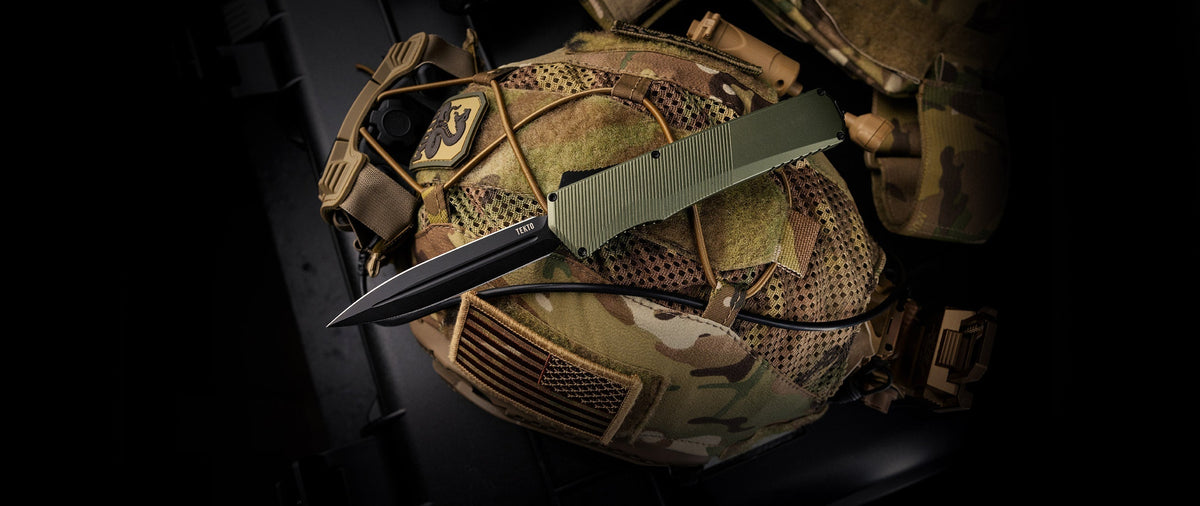
Nearly every knife in this story so far is a side-opener, a blade that swings out on a pivot like a folding knife, only faster. The out-the-front automatic, where the blade travels straight out of the handle along a track, is a different mechanism with a different history. Single-action OTFs, which fire the blade out on a spring and are retracted by hand with a slider, were being made in Europe by the early twentieth century, and the paratrooper gravity knife is a cousin. The modern double-action OTF, where one thumb slider both fires and retracts the blade and the mechanism resets itself, became a production item in the United States in the 1990s, and it is the design that has defined the automatic knife since the repeals began. The side-opener is a folding knife with a spring. The double-action OTF is a knife that lives in a handle and comes out when asked. The OTF guide explains how the mechanism works, and the whole TEKTO A-series, from the 1.85-inch A2 Badger to the 3.60-inch double-edged A7 Zastava, is double-action OTF.
One detail of the law follows the mechanism. A double-action OTF fires at the touch of a slider, so it is a switchblade everywhere a side-opening automatic is. The 2009 assisted-opening exemption does not reach it. Where OTFs are legal, they are legal as automatics, and where automatics are restricted, so are they.
What the Switchblade Is Now
Sixty years after the act, the switchblade has gone back to being what George Schrade sold in 1893: a pocketknife for people who need one hand free. The modern automatic is machined aluminum rather than celluloid, it runs a powder steel blade rather than a carbon one, and it is far more likely to open a box than to appear in a film. The panic of the 1950s is a case study in how a law gets written around an image, the stiletto in the movie, rather than a thing, and in how long such a law lasts once written. Its one lasting lesson for a knife owner is practical. Because the bans were written around the mechanism, the law still cares whether your knife opens itself, and it varies by state and sometimes by city. Know where you stand before you carry one. The types of automatics guide sorts the mechanisms, the 50-state guide sorts the law, and the knife history page puts all of it in the longer story of the knife.
The Modern Automatic
Four double-action OTFs and a side-opening button lock, from the 1.85-inch Badger to the double-edged Zastava.


People Are Asking
When was the switchblade invented?
Spring-fired knives appeared in the late 1700s, probably first in Italy, after Benjamin Huntsman's 1742 crucible steel made small reliable springs possible. The first practical American automatic was George Schrade's push-button knife, patented in 1892.
Why were switchblades banned?
A 1950 magazine article, "The Toy That Kills," and a run of 1950s films about juvenile delinquents tied the Italian stiletto to gang violence. New York banned sales in 1954 and Congress passed the Federal Switchblade Act on August 12, 1958.
What does the Federal Switchblade Act actually prohibit?
Manufacturing, importing or transporting switchblades in interstate commerce, and selling them on federal land. It does not prohibit owning or carrying one. Those are state questions. It exempts the military, common carriers and people with one arm carrying a blade of three inches or less.
Did the U.S. military issue switchblades?
Yes. The Army approved the M2 paratrooper knife in December 1940, based on Schrade's Presto, and the Air Force issued the MC-1 aircrew knife from 1958 to 1993.
When did states start legalizing switchblades?
New Hampshire repealed its ban in 2010. More than twenty states have followed, including Texas, Kansas and Indiana in 2013, Colorado and Michigan in 2017, Ohio in 2021 and Vermont in 2025, and a Massachusetts court struck down that state's ban in 2024.
Are switchblades legal now?
In a large majority of states, yes, to own and usually to carry, with the remaining restrictions concentrated in the Northeast and on the West Coast and in a few blade-length rules. Check the 50-state guide for your state and any city ordinance.
What is the difference between a switchblade and an OTF?
Both are automatics. A switchblade in the traditional sense is a side-opener, a folding knife whose blade swings out on a spring. An OTF's blade travels straight out of the front of the handle on a track. The modern double-action OTF fires and retracts with one slider. Legally both are switchblades.
Are assisted-opening knives switchblades?
Not under federal law since 2009. A knife with a spring that creates a bias toward closure and is opened by thumb or wrist pressure is exempt from the Federal Switchblade Act. Some states define the term differently, so check the state page.
What was the first switchblade movie?
Blackboard Jungle and Rebel Without a Cause, both 1955, were the first widely seen films to put a stiletto in a delinquent's hand, followed by 12 Angry Men in 1957 and West Side Story on stage the same year.