The Short Version
A folder clipped tip-up in the front pocket on your dominant side, in a pocket with nothing else in it. A fixed blade in a Kydex sheath on the belt at three or four o'clock, or scout carry across the back. An OTF clipped with the slider up and the handle showing. A lanyard when your hands are wet, gloved or over water. And in every case, a look at your state's rule on concealment before you decide how much of the knife shows.
The first version of this page listed four ways to carry a knife and the benefits of each. This one explains how to set each one up, because the difference between a knife you carry every day and a knife that lives in a drawer is almost always comfort and access, and both are decided by details: which way the clip points, which pocket, where on the belt. It also takes the law seriously, since the same knife carried two different ways can be legal and illegal in the same state. The everyday carry guide covers what goes in the other pockets. This one is about the knife.
Start With the Law: Open, Concealed and the Clip
Most state knife laws care about two things, what the knife is and whether it is concealed, and carry method is the second one. A few states define concealed precisely. South Dakota says a knife is not concealed "if any part" of it "is capable of being seen," which makes a visible clip open carry. North Dakota says a knife in a belt sheath that is "wholly or substantially visible" is not concealed, and one under a coat is. Others leave it to the courts, and courts have gone both ways on whether a clipped folder with the handle showing is concealed. For an ordinary folder this rarely matters, because most states do not restrict concealed carry of a plain pocketknife. It matters a great deal for fixed blades, which several states require to be carried openly, for automatics and double-edged knives, which many states restrict when concealed, and for any knife over a length limit, which is usually a concealed-carry limit. California is the clearest case: a fixed blade of any size must be carried openly in a sheath on the belt, and a folder may be carried concealed only if it is closed.
The rule for this page is that the carry method follows the law of the place, not the other way around. Read your state's page in the 50-state guide before you choose between a clip that hides the knife and one that shows it, and if the law turns on visibility, carry so that it is visible.
The Pocket Clip: Tip-Up, Tip-Down, Left and Right
The pocket clip is the reason the modern folder exists, and it has four positions. Tip-up puts the blade's tip at the top of the pocket, so the knife comes out ready to open with the thumb. It is the fastest and the standard on most modern folders, and its one risk is a blade that opens a fraction in the pocket, which a good detent or lock prevents. Tip-down puts the pivot at the top, so the knife must be turned in the hand before opening. It is slower and safer with a knife whose detent is weak. Right or left side follows the hand. Most people carry on the dominant side in the front pocket, with the clip on the outside seam so the knife rides at the back of the pocket, against the hip, where it does not interfere with anything else going in and out. The F1 Alpha and A5 Spry Mini come with ambidextrous clip mounting. The F2 Bravo carries on a machined titanium clip that is part of why the knife feels the way it does in the hand. The left-handed guide goes through the options for the other side.
Two habits make the clip work. Give the knife its own pocket, or at least its own side of one. Keys and coins scratch the handle, catch the clip and, on an OTF, get into the track. And check the clip tension once in a while: a clip that has loosened lets the knife ride up and out when you sit, and a clip bent too tight tears pocket seams and makes the draw a struggle. Clip screws take a drop of thread locker and a quarter turn, nothing more.
Deep Carry, and Carrying Loose
A deep-carry clip mounts at the very end of the handle so that only the clip itself shows above the pocket seam. It is the discreet carry, for the office, the city and anywhere a visible knife handle draws a comment, and it keeps the knife lower in the pocket where it is less likely to be lost or lifted. The costs are a slower draw, because there is less handle to grip, and a lint problem, because the knife sits at the bottom of the pocket. And it has a legal side: in a state where a visible handle is what makes the carry open, deep carry is concealed carry. Know which you want before you choose the clip.
Carrying loose, with no clip at all, is how pocketknives were carried for three hundred years and it still works for small ones. A slipjoint, a A2 Badger at 2.18 ounces or an A5 Spry Mini at 2.15 ounces disappears in a front pocket or the watch pocket of a pair of jeans, which is the best loose-carry pocket there is. The rules are the same: its own pocket, no keys, and for an OTF, the slider toward your body where it cannot be pushed by something else in the pocket. A knife carried loose in a jacket or bag pocket is a knife you will have to dig for, which is why the clip was invented.
Fixed Blades: Belt, Scout, Neck and Pack
A fixed blade is carried in its sheath, and the sheath decides everything. Kydex, the thermoformed plastic the X1 Atlas ships in, holds the knife by friction with a click, does not absorb water or blood, and takes a belt clip or loop in several positions. Leather is quieter and kinder to the blade finish, and needs a retention strap and some care in the wet. The positions are vertical on the belt, at three or four o'clock for a right-hander, which is the easiest draw and the one most states have in mind when they say "openly in a sheath". Scout carry, horizontal across the small of the back or behind the hip with the handle toward the drawing hand, which keeps the knife out of the way when you sit, bend or carry a pack and draws across the body. Cross-draw, vertical on the opposite hip, which some people prefer when driving. Neck carry, for a small knife on a cord under or over a shirt, which puts it where both hands can reach it but is concealed carry almost everywhere. The Atlas sheath has an adjustable belt clip that handles the first two.
Three rules for all of them. Do not carry a fixed blade on the front of the belt, where a fall drives the handle into you. Set the retention so the knife will not fall out if you are upside down, and test it. And know the law: fixed blades are the knives most often restricted when concealed, and in several states, California among them, a fixed blade under a jacket is a misdemeanor and the same knife on the belt in view is not. In the pack is the other option, and for a hunting or camp knife that is not needed until camp, it is the right one. The hunting knife guide covers the choice.
Lanyards
A lanyard is a loop of cord through the hole in the butt of the handle, and it has three uses. The first is retention when a drop means losing the knife: over water, on a ladder, in snow. Loop it around the wrist while you cut, and take it off before you do anything else, because a lanyard around the wrist near a running machine is a hazard. The second is retrieval: a lanyard that sticks up out of the pocket gives a gloved or wet hand something to grab, and it is why the F3 Charlie and the glass breaker spacer on the F1 Alpha have a lanyard hole. The third is a grip extension on a small knife, which is how the Badger and the Spry Mini become usable in a thick glove. Keep it short, a few inches, with a bead or a knot at the end. A long dangling lanyard catches on things and is the one piece of carry gear that makes a knife more likely to come out of the pocket, not less. We sell a lanyard, and paracord from any hardware store does the same job.
Carrying an OTF
An OTF rides in a pocket like any folder with a clip, with three differences. The slider must be where your thumb finds it and nothing else does: clipped tip-up with the slider facing out, or loose in the watch pocket with the slider toward your body, never in a pocket with keys that can push it. The blade must be fully retracted before the knife goes in the pocket, every time, confirmed by feel. And the track must be kept clean, because an OTF carried at the bottom of a lint-filled pocket for a month is an OTF that misfires. The cleaning guide covers the monthly blowout. The A5 Spry at 3.49 ounces is the size most people carry daily. The A3 Delta, which is a side-opening automatic rather than an OTF, has a safety switch beside the button that is engaged for carry and released to fire.
The legal note is the one from the top of the page. An automatic is restricted when concealed in a number of states and restricted outright in a few, and in most of those states the clip does not make it open carry. Where automatics are legal to own but not to conceal, the OTF rides openly, in a belt sheath or clipped with the whole handle showing, or it rides in the trunk. The 50-state guide is the reference. The OTF blade length guide explains why the 1.85-inch Mini and Badger exist.
Where a Knife Cannot Go, However It Is Carried
No carry method gets a knife past the places that bar all of them. Airport security takes every knife, so a traveling knife goes in checked baggage, sheathed or closed and wrapped, and nothing goes in the carry-on. Federal buildings and courthouses screen for knives at the door, and nearly every state courthouse does the same, so the knife stays in the car. In a state that treats a glove box as concealment, it stays in the trunk. Virtually every school bars knives for everyone. Most stadiums, arenas and concert venues bar them, bars and places that serve alcohol restrict them in many states, and any private business or employer can bar them and ask you to leave. The rule of thumb is that the knife stays home or in the car on any day that involves a metal detector, a courtroom, a school, an airport or a drink, and the state pages in the 50-state guide list the places each state names.
Driving, Sitting and the Car
The two places a clipped knife is most often lost are the car seat and the office chair, and the fix is the same for both: carry it at the back of the pocket, against the hip, with the clip outboard, where the seat belt and the chair arm do not catch it. A tip-up clipped knife in the front of the pocket is the one that rides up and ends up on the floor of the car. In the car itself the question is legal rather than practical. Several states treat a knife in a glove box, a console or under a seat as concealed on the person, and some treat a locked trunk as the only place a restricted knife may be transported. A few treat the vehicle as an extension of the home where anything may be kept. The state pages have the rule, and the safe default where you do not know it is the trunk.
Comfort: Weight, Size and Which Pocket
The knife you carry is the one you forget is there. For most people that means under four ounces and under four inches closed in a front pocket, and the TEKTO line runs the whole range: the F2 Bravo at 2.4 ounces, the A5 Spry Mini and A2 Badger at just over 2, the F4 Echo at 2.64, the F1 Alpha at 3.03, the A5 Spry at 3.49, the X1 Atlas at 3.88 before the sheath, the F3 Charlie at 4.5 and the A3 Delta at just under 6. A knife over four ounces is a belt knife or a work knife, carried in a pocket with nothing else or in a pouch. The knife weight guide goes into what the ounces mean in the hand. Many people settle on two knives: a small OTF or folder that is always in the pocket, and a larger folder or fixed blade that comes out for the job site, the trail or the hunt. The table puts a setup to each kind of day.
| Day | Knife | Carry |
|---|---|---|
| Office and city | F2 Bravo or A5 Spry Mini | Tip-up clip or deep carry, front pocket, dominant side. Check the state rule on visible carry |
| Job site | F3 Charlie or A5 Spry | Tip-up clip, dedicated pocket, short lanyard for gloved hands |
| Trail and camp | X1 Atlas plus a folder | Atlas in Kydex at four o'clock or scout carry. Folder clipped |
| Hunting | X1 Atlas | Belt sheath while hunting, in the pack on the walk in. A folder for the small work |
| Travel by air | Whichever you choose | Closed or sheathed in checked baggage. Nothing in the carry-on. Check the destination state |
| Driving across states | Folder in the pocket, anything restricted in the trunk | The state pages have the vehicle rule for each state you cross |
Four Ways to Carry
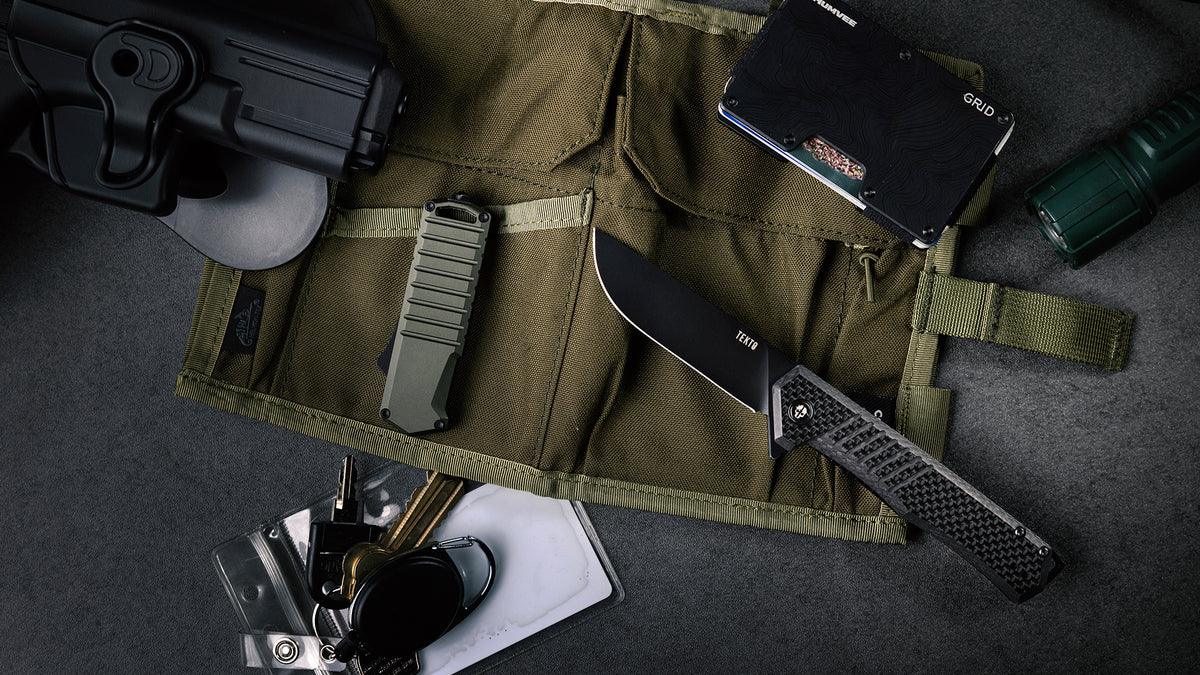
A titanium-clipped folder, the everyday OTF, a Kydex-sheathed fixed blade and the watch-pocket automatic.


People Are Asking
What is the best way to carry a pocket knife?
Clipped tip-up in the front pocket on your dominant side, in a pocket with nothing else in it. It is the fastest draw and keeps the knife where it will not be lost. Check your state's rule on whether a visible clip counts as open carry.
Is tip-up or tip-down better?
Tip-up is faster, because the knife comes out of the pocket ready to open with the thumb, and it is the standard on most modern folders. Tip-down is safer with a knife whose detent is weak, since the blade cannot open in the pocket.
Does a visible pocket clip count as open carry?
In some states, yes: South Dakota says a knife is not concealed if any part can be seen. In others the courts have gone both ways, and in a few the whole knife must be visible. It matters most for fixed blades, automatics and knives over a length limit. Read your state's page.
How should I carry a fixed blade knife?
In its sheath on the belt at three or four o'clock, or horizontally across the back (scout carry). Not on the front of the belt. Several states require a fixed blade to be carried openly, in view, so do not cover it with a jacket where that rule applies.
What is scout carry?
A fixed blade carried horizontally across the small of the back or behind the hip, handle toward the drawing hand. It stays out of the way when you sit or wear a pack and draws across the body.
How do I carry an OTF knife?
Clipped tip-up with the slider facing out, or loose in the watch pocket with the slider toward your body, in a pocket with no keys. Retract the blade fully before pocketing and keep the track clean. In states that restrict concealed automatics, carry it openly or in the trunk.
Should I use a lanyard on my knife?
When a drop means losing the knife, over water, on a ladder, in snow, or when you work in gloves. Keep it short, with a bead or knot at the end, and take it off your wrist before doing anything with a machine.
Can I keep a knife in my glove box?
Depends on the state. Several treat a glove box, console or under-seat as concealed carry. Some allow only a locked trunk for restricted knives. A few treat the car as home. The safe default when you do not know the rule is the trunk.
Can I bring a knife on a plane?
In checked baggage, yes, closed or sheathed and wrapped. Never in the carry-on. Security takes every knife, including the smallest. Check the law in the state you are flying to.