The Short Version
A folding knife is a blade, a pivot, a handle and a lock, and everything else is a detail of one of those four. The blade decides what the knife cuts and how long it stays sharp: steel, shape and grind. The pivot decides how it opens: bearings or washers, a flipper tab or a thumb stud, and how firm the detent is. The handle decides how it feels and what it weighs: the scales, the liners and the clip. The lock decides whether you can trust it: liner, frame, button, lockback or crossbar. Below is each part labelled on a diagram, what it does, what the choices are, how the types of pocket knife differ, what the strength tests actually test, and a short way to pick one. TEKTO's four manual folders, the F1 Alpha, F2 Bravo, F3 Charlie and F4 Echo, are the examples throughout, with their specs in one table at the end.
The Parts, Front to Back
Start at the tip. The point is where spine and edge meet, and how much steel backs it is the whole story of blade shape. The spine is the thick, unsharpened back. Near the handle it often carries jimping, a row of grooves cut for the thumb so it does not slip forward. The edge is the sharpened side and the belly is the curved stretch of it near the tip, where slicing happens. Where the blade enters the handle is the tang, the part the lock bears on, and the pivot is the screw it swings around. On a flipper, a small tab on the tang sticks out of the handle when the knife is closed. Press it and the blade swings open. The handle is two scales, the outer panels you hold, over liners, the thin metal plates that give the handle its stiffness and, on a liner lock, form the lock itself. A spacer or backspacer holds the two sides apart at the back. On the F1 Alpha the glass breaker does that job and carries the lanyard too. The pocket clip is screwed to one scale and decides how the knife rides. The lanyard hole is a hole through the butt for a cord. Our blade shapes guide covers the tip end in detail.
The Blade: Steel, Shape and Grind
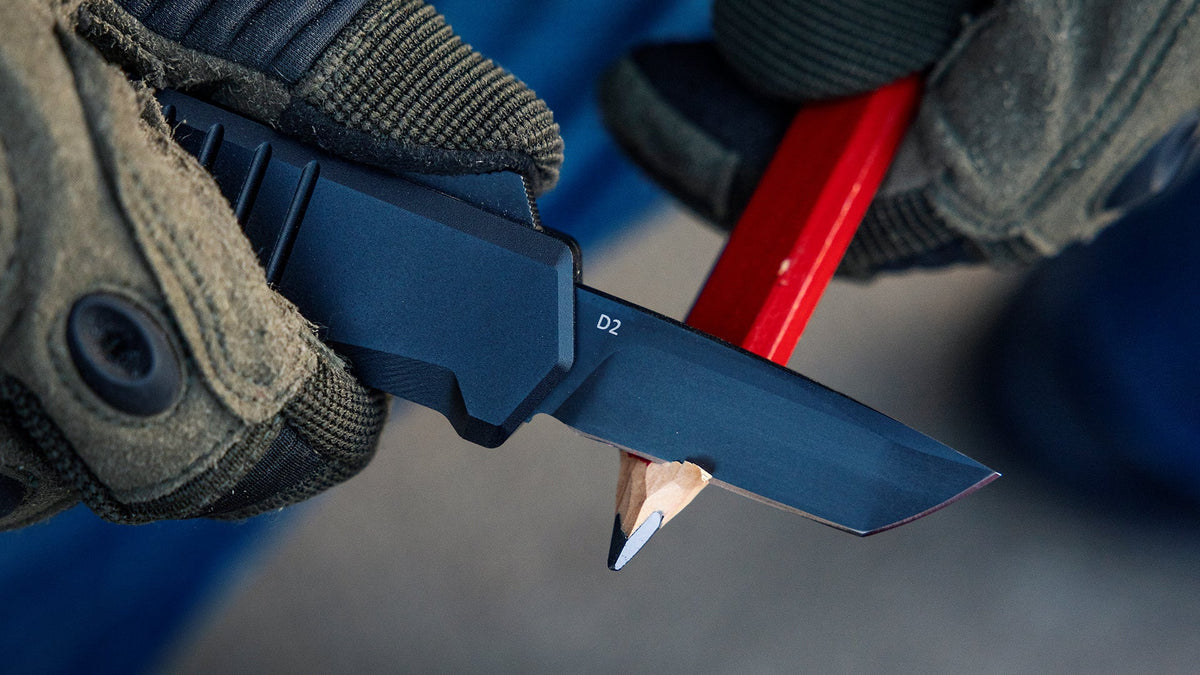
Three things decide how a blade cuts. Steel is the first: it sets how long the edge lasts, how hard it is to sharpen, and whether it rusts. TEKTO's folders run titanium-coated D2 on the F1, F2 and F3, a tool steel that holds an edge well, sharpens quickly and wears a coating because it is not quite stainless, and S35VN on the F4 Echo, a powder stainless that holds an edge longer and resists rust bare. Our D2 guide and MagnaCut guide compare them. Shape is the second: the drop point on the F2 and F3 is the all-rounder, the reverse tanto on the F4 trades a little belly for a reinforced tip, and the modified straight back on the F1 puts the point high over a long flat edge. Grind is the third and the one most buyers skip: it is how the blade thins from spine to edge in cross-section. A full flat grind, which the F1 Alpha carries, tapers in one plane from spine to edge and slices best. A saber or hollow grind leaves more steel at the spine for strength at some cost to slicing. Whatever the grind, the final edge on a TEKTO is about 20 degrees per side, which is what to set a sharpener to.
The Pivot and the Action
The pivot is one screw, and it decides how the knife feels more than any other part. The blade turns on either washers, thin rings of bronze or plastic, or ball bearings, a ring of small balls in a cage. Washers are simple and tolerate dirt. Bearings are faster and smoother and are why a modern flipper opens with a flick. The F1 Alpha and F2 Bravo run on ceramic ball bearings. The detent is a small ball on the lock bar that drops into a hole in the tang and holds the blade closed. A good detent keeps the blade shut in the pocket and gives the flipper something to pop against. How you open the knife is the last choice: a flipper tab you press with the index finger, a thumb stud on the blade, a thumb hole through it, or on an automatic a button or slide that does the work for you. All four TEKTO folders are flippers, which is the easiest one-handed open to learn and works the same in either hand.
Locks, and Which One You Want
A lock holds the blade open so it cannot fold onto your fingers, and the kinds differ in where the locking part lives. A liner lock is a sprung section of the handle liner that springs sideways behind the tang when the blade opens. You close it by pushing the liner back with your thumb and folding the blade. It is simple, light and the most common lock in modern folders. The F1 Alpha and F2 Bravo use it. A frame lock is the same idea cut from a thick handle slab instead of a thin liner, stronger and heavier. A button lock is a sprung plunger through the tang: press the button and the blade is free, release it and the blade is held, open or closed. It keeps your fingers out of the blade's path entirely and works the same in either hand. The F3 Charlie and F4 Echo use it, and the F3's holds the blade closed as well as open. A lockback is a rocker bar along the spine that drops into a notch in the tang, the traditional strong lock. Press the bar's tail to release. A crossbar lock, the one Benchmade made famous as the AXIS, is a spring-loaded bar through the tang, pulled back with thumb and finger from either side. And a slipjoint has no lock at all, only a backspring that holds the blade open by tension, which is why traditional pocket knives are legal in a few places that restrict locking blades. For most people the choice is between a liner lock, which is lighter, and a button lock, which keeps fingers clear and favors no hand.
The Handle: Materials and Shape
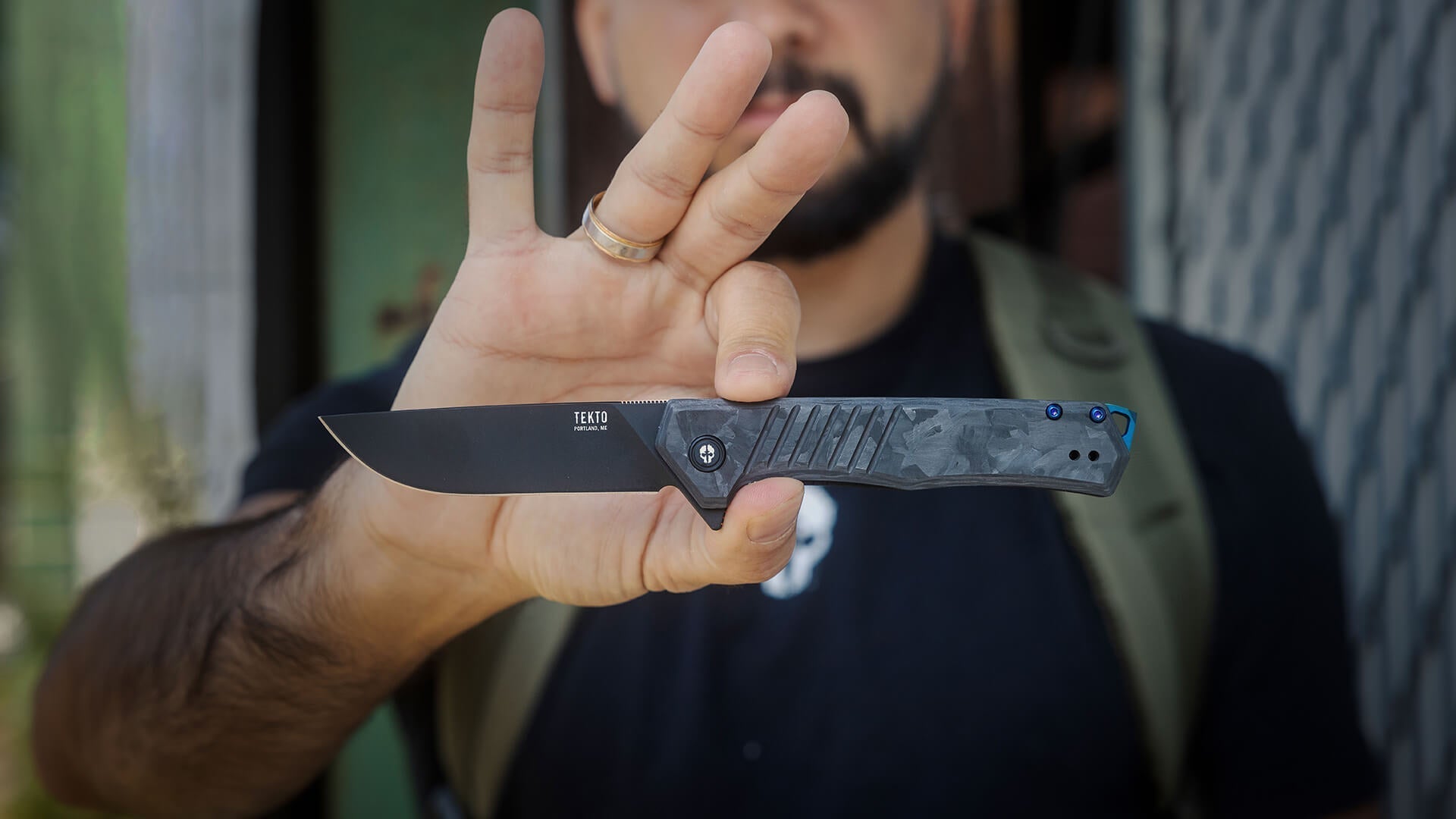
The scales set the grip, the weight and the look. G10 is a fiberglass laminate, light, strong, unaffected by water and textured for grip. It is the workhorse of the F-series. Carbon fiber is lighter and stiffer and looks the part. Forged carbon is chopped carbon fiber pressed in resin, with a marbled surface that is different on every knife. Aluminum, 6061-T6 on the F4 Echo, is hard-anodized metal that stays slim and takes color well. Titanium is the premium choice, strong and light at a price. Under the scales are the liners, which stiffen the handle. The F2 Bravo recesses its liners inside the scales so the handle edge is clean. Shape matters as much as material: look for a handle that fills your palm, a slight swell at the back so the hand does not slide, a finger groove or guard where the index finger sits, and jimping where the thumb lands on the spine. Hot spots, the corners and clip ends you feel after a minute of cutting, are the thing to check in a store.
Weight and Size
The number that decides whether you carry a knife every day is weight, and the line is about 3 ounces: under it a folder disappears in a pocket, over it you know it is there. The F2 Bravo is 2.4 ounces, the F4 Echo 2.64, the F1 Alpha 3.03, and the F3 Charlie, a full-size knife with a 3.80-inch blade, 4.50. Weight comes from blade length, liner thickness and handle material. A lighter knife is not a weaker one, because strength lives in the lock and the pivot, not in the ounces. Blade length is the other size decision. Between 2.75 and 3.5 inches is the everyday range, long enough for food and cardboard, short enough to fold into a handle that fits a front pocket, and short enough for the many towns and states that draw a line at 3 or 3.5 inches. Our knife law guides have the limits. Closed length follows blade length and decides whether the knife rides in a jeans pocket or a jacket. Match the knife to the hand that will hold it and the pocket that will carry it, in that order.
Clip, Lanyard and Glass Breaker
The pocket clip decides how the knife rides. Tip-up carry puts the blade's point toward the pocket opening so the knife opens straight from the draw. Tip-down is the reverse and keeps the tip buried. A deep-carry clip hides the whole knife below the pocket seam. Ambidextrous means the clip can be moved to the other scale for the left pocket. The F1 Alpha's is, and all TEKTO OTFs come with one, and our left-handed guide covers the rest. A lanyard hole takes a short cord that gives a small knife more to hold and makes it easier to find in a bag. A glass breaker is a hardened point on the butt for breaking a car window in an emergency, and on the F1 Alpha it also serves as the handle spacer and the lanyard point. None of these is essential. A clip you will use is the one that matters.
The Types of Pocket Knife
Pocket knives sort by how they open and how they stay open, and the table below runs from the oldest design to the newest.
| Type | How it opens | How it stays open | Notes |
|---|---|---|---|
| Slipjoint (traditional) | Two hands, nail nick | Backspring tension, no lock | The classic. Legal in some places that restrict locking blades |
| Multi-blade and multi-tool | Two hands | Backspring. Some tools lock | Several blades or tools on one frame. A toolbox, not a cutter |
| Lockback | Two hands or thumb stud | Rocker bar on the spine | Strong and simple. Slower to close |
| Modern manual folder | One hand: flipper, thumb stud or thumb hole | Liner, frame, button or crossbar lock | TEKTO F1, F2 (liner lock), F3, F4 (button lock) |
| Assisted opener | Start it by hand, a spring finishes | Liner or frame lock | Legal where automatics are not, in most states |
| Side-opening automatic | Button. A spring swings the blade out | Button lock | TEKTO A3 Delta, A3 Delta Mini |
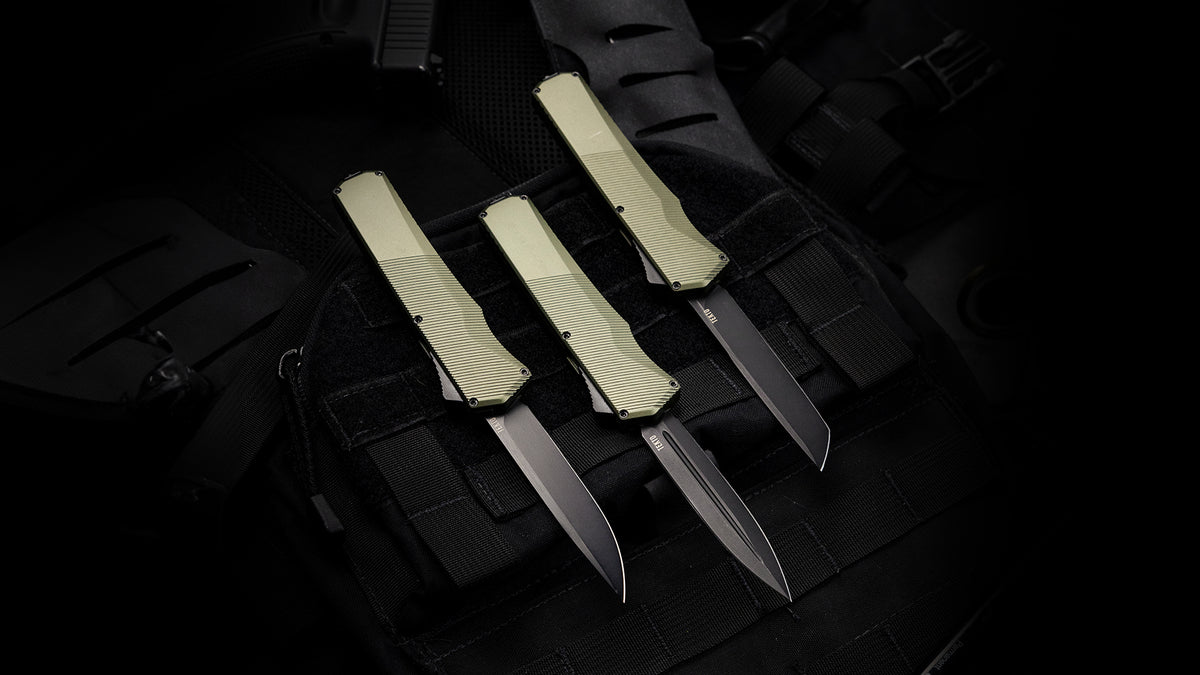
| OTF automatic | Slide. The blade fires straight out the front | Locks at both ends of travel | TEKTO A2, A4, A5, A7 |
Everything on this page applies to all of them, with one difference: automatics and OTFs have the opening built into the handle, so the choice of flipper, bearings and detent is made for you, and the law treats them differently, which our 50-state guide covers.
What the Strength Tests Actually Test
Knife reviewers run a handful of abuse tests, and each one measures a single part. The spine whack, striking the back of the open blade against a hard surface, tests whether the lock holds under a shock from the wrong direction. A lock that slips is the one failure that puts fingers in the blade's path. The load test, hanging weight from the handle with the blade clamped, measures the same lock in pounds. The tip test, driving the point into a hard surface, tests blade shape and heat treatment together. Rope cuts count how many passes an edge makes before it dulls, which is a steel and grind test. The flex test bends a blade until it snaps, which measures toughness, the opposite of hardness. You do not need to abuse a knife to learn most of this. Open it and try to wiggle the blade up and down and side to side: a good lock-up has no play. Look down the spine from the butt with the knife closed: the blade should sit centered between the scales. Press the spine gently against a table with the knife open: the lock should not move. Shake the closed knife: the detent should hold the blade shut. That ten-second check tells you more than any video.
How to Choose One
Five questions, in order. What will it cut most days: boxes and cord want a drop point or tanto, food wants belly, both want a plain edge. Which pocket and which hand: that sets the weight ceiling, the closed length and whether the clip must move. Which lock: liner for the lightest knife, button if you want fingers clear and either-hand use. Which steel: D2 if you sharpen your own and want to spend less, S35VN or MagnaCut if you want to forget about the edge. And what the law allows where you live, which decides length and whether an automatic is on the table at all. TEKTO's four manual folders answer those questions four ways.
| F1 Alpha | F2 Bravo | F3 Charlie | F4 Echo | |
|---|---|---|---|---|
| Blade | 3.10 in, modified straight back, full flat grind | 3.30 in, drop point | 3.80 in, drop point | 3.40 in, reverse tanto |
| Steel | Titanium-coated D2, 58-60 HRC | Titanium-coated D2, 58-60 HRC | Titanium-coated D2, 60-62 HRC | Titanium-coated S35VN, 60-62 HRC |
| Open | Flipper, ceramic bearings | Flipper, ceramic bearings | Flipper | Flipper |
| Lock | Liner lock | Liner lock | Button lock | Button lock |
| Handle | G10 and carbon fiber, 4.50 in | G10 and carbon fiber, recessed liners, 4.30 in | G10 and forged carbon, 5.20 in | 6061-T6 aluminum with G10 inlays, 4.35 in |
| Weight | 3.03 oz | 2.4 oz | 4.50 oz | 2.64 oz |
| Extras | Glass breaker and spacer, lanyard point, ambidextrous clip | Machined titanium clip and accents | Titanium barrel spacers, lanyard hole, thumb jimping | Zastava collaboration |
| Price | From $119.99 | From $139.99 | From $129.99 | From $199.99 |
| Pick it for | The slicer, the lightest with a glass breaker | The lightest, the everyday carry | The big jobs, the full-size handle | The best steel and the reinforced tip |
The Four Folders
Two liner locks, two button locks, 2.4 to 4.5 ounces.


People Are Asking
What are the parts of a folding knife?
Point, spine, edge and belly on the blade. The tang, which the lock bears on. The pivot it turns on. The handle scales over liners, with a spacer at the back. The lock. The pocket clip, lanyard hole and, on some knives, a glass breaker. The diagram above labels each one.
What do you call a knife that folds?
A folding knife, folder or pocket knife. By how it opens it may be a slipjoint, a lockback, a flipper, an assisted opener, an automatic or an OTF, and the table above sorts them.
How do you close a folding knife?
Keep your fingers out of the blade's path, then release the lock. On a liner lock, push the sprung liner sideways with your thumb and fold the blade with your other fingers. On a button lock, press the button and fold. On a lockback, press the tail of the bar on the spine. On a crossbar, pull the bar back with thumb and finger.
Which knife lock is the strongest?
Frame locks, lockbacks and crossbar locks test strongest under load. A well-made liner lock or button lock holds far more than any hand task applies. What matters more than the type is the fit: no blade play when open and no movement when you press the spine gently.
Liner lock vs button lock: which is better?
A liner lock is lighter and simpler. A button lock keeps your fingers clear of the blade when closing and works the same in either hand. TEKTO uses a liner lock on the F1 and F2 and a button lock on the F3 and F4.
What is the best blade length for everyday carry?
Between 2.75 and 3.5 inches. It is long enough for food and cardboard, folds into a pocketable handle, and stays under the 3- or 3.5-inch limits that many towns and states set. TEKTO's folders run 3.10 to 3.80 inches.
Is a heavier knife stronger?
No. Strength lives in the lock and the pivot, not the weight. A 2.4-ounce F2 Bravo with a solid liner lock holds its blade as surely as a heavier knife. The extra ounces in a big folder buy blade length and handle size, not safety.
Are folding knives legal to carry?
An ordinary manual folder is legal to own in every state and legal to carry in most, with limits on blade length, concealment and places such as schools in some. Automatics are regulated separately. Our state knife law guides have the specifics.