The Short Version
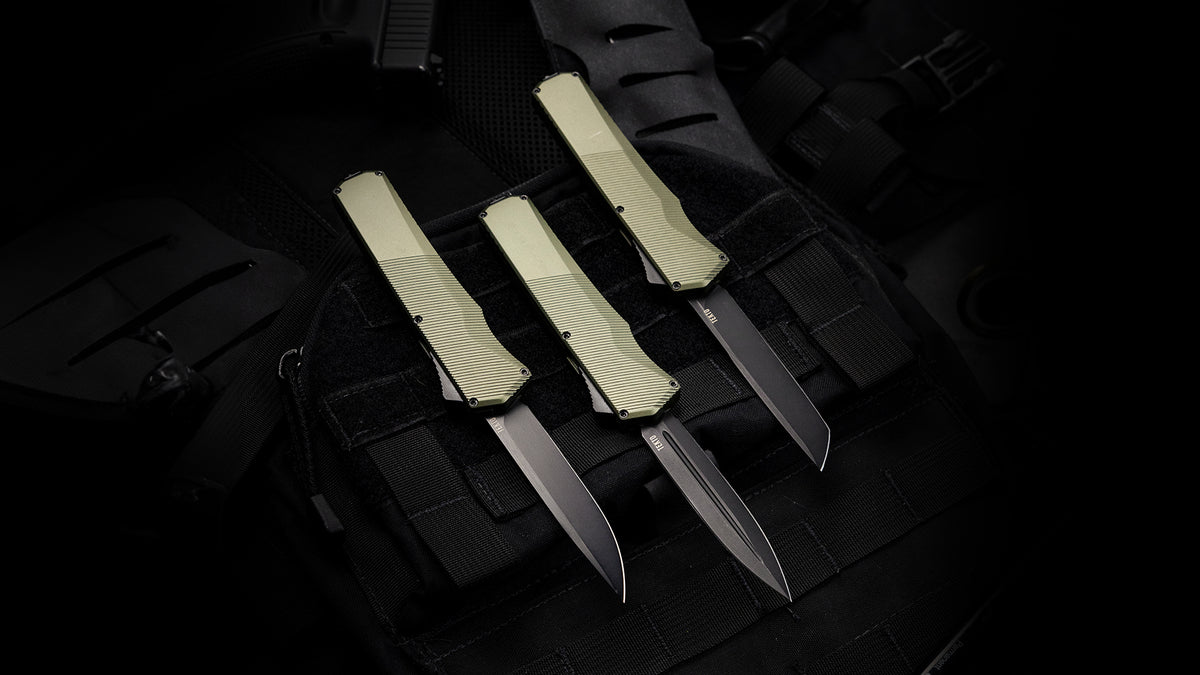
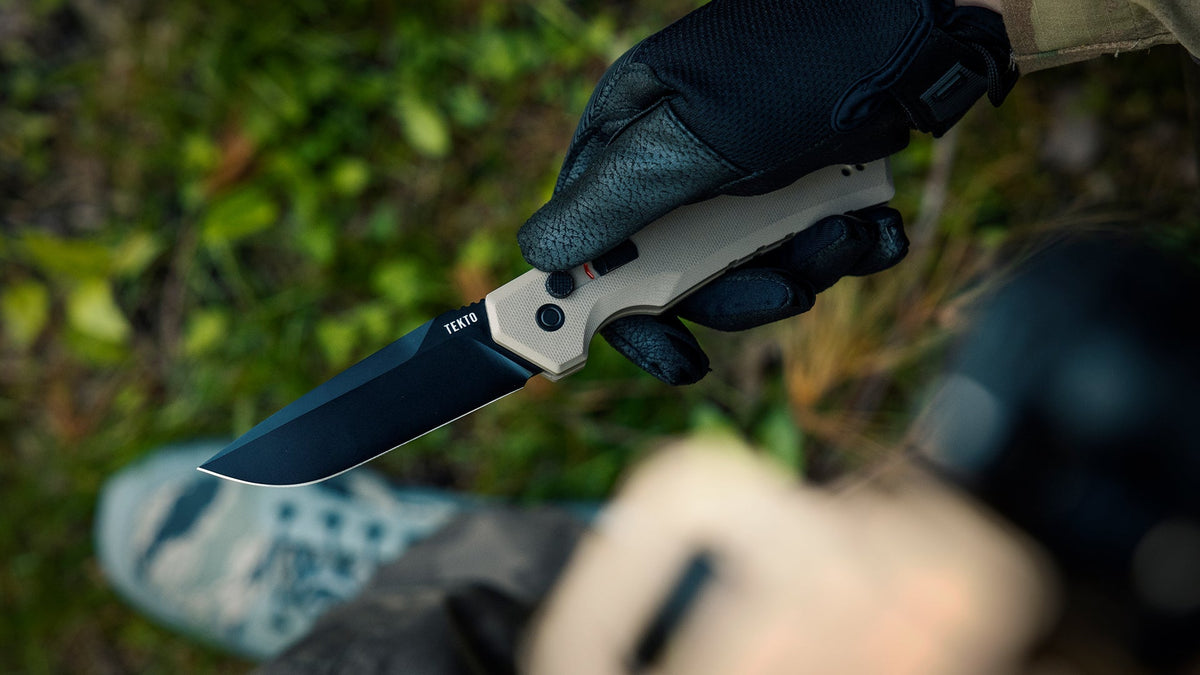
A tanto blade has a straight main edge and a short second edge that meets it at an angle, so the point is backed by almost the full thickness of the spine instead of tapering to a fine tip. That makes it the strongest point you can put on a pocket knife, and the one that pries, scrapes, scores and pierces without rolling or snapping. It also means no belly, so a tanto cuts in straight pushes rather than long slicing draws, and it sharpens as two flats instead of one sweep. The name comes from the Japanese tantō, a short blade carried for centuries, but the angular shape on modern folders and OTFs is an American design from the 1980s. TEKTO offers the tanto on the A5 Spry, A5 Spry Mini, A2 Badger and F2 Bravo EOTECH Edition, and a reverse tanto on the F4 Echo.
Where the Tanto Comes From
The Japanese tantō was a short blade, under about a foot, carried alongside the sword from the Heian period onward and used for everything from close work to ceremony. Its blade was a gentle curve with a single edge, nothing like the angular profile the word brings to mind today. That profile, the American tanto, appeared in the early 1980s when an American maker took the idea of a reinforced point and drew it as two straight edges meeting at a hard corner, with the spine kept thick almost to the tip. It became the shape of the hard-use folder, then of the OTF, where a strong point matters because the blade travels in a track and the tip is the part that touches the world first. When a modern knife says tanto, it means the American shape.
The Geometry: Two Edges, Two Points
Look at a tanto from the side and you see a straight primary edge running most of the blade's length, a corner, and a short secondary edge rising at an angle to meet the spine at the tip. The corner is itself a point, a second one, and it is the part of the blade that does the tanto's signature jobs: it scores a line, starts a cut in a strap, catches the edge of a staple. The spine stays thick to within a fraction of an inch of the tip because there is no curved belly asking it to taper, which is why a tanto point survives being twisted in a lid or driven into a hard surface where a fine clip point or a thin drop point tip would bend. The trade is the belly. With a straight primary edge there is no sweeping curve to draw through material, so slicing a tomato, skinning game or taking long cuts through cardboard takes more passes than a drop point needs.
What a Tanto Is Good At
Anything that loads the tip. Prying a staple or a lid with the point, scoring drywall, cardboard or plastic sheet along a straightedge, opening a can in a pinch, punching a drain hole, cutting straps and zip ties with the corner, and piercing packaging, tires or hose where a thin tip would flex. The straight primary edge is also better than a belly for push cuts on a board or against a surface, and the short secondary edge works as a small chisel for scraping. For the workday that is boxes, straps, blister packs and the occasional pry, a tanto is the right shape, and because the strength is in the point, a short tanto like the 1.85-inch A2 Badger or A5 Spry Mini does the same jobs as a long one.
What It Is Not Good At
Slicing, which is most of what a kitchen or a hunting camp asks of a knife. Without a belly the tanto cannot roll through a cut, so food prep, skinning and long draw cuts through rope or foam are slower and rougher than with a drop point. The corner can also catch when you try to slice in one motion, because the edge changes direction partway along. And it is slightly more work to sharpen, since two flats must be kept flat rather than one curve followed. None of that is a fault. It is the trade that buys the point. If your day is slicing, buy a drop point. If it is prying and piercing, buy the tanto. If it is both, the reverse tanto below is the compromise.
Tanto vs Drop Point
| Tanto | Drop point | |
|---|---|---|
| Edge | Straight primary edge plus a short angled secondary edge | One continuous curve with a belly |
| Tip | Thick, reinforced, high | Lowered, strong, thinner than a tanto |
| Piercing hard material | Excellent. The tip does not roll | Good |
| Prying and scraping | Excellent | Fair |
| Slicing and food | Fair | Excellent |
| Skinning | Poor | Excellent |
| Sharpening | Two flats, keep the corner crisp | One continuous stroke |
| Best for | Boxes, straps, prying, piercing, hard-use carry | Everything else, and one knife for everything |
| From TEKTO | A2 Badger, A5 Spry, A5 Spry Mini, F2 Bravo EOTECH Edition | F2 Bravo, F3 Charlie, A3 Delta, A5 Spry Drop Point, X1 Atlas |
Tanto vs Reverse Tanto
A reverse tanto moves the corner from the edge to the spine. The spine runs straight, then drops at an angle to a tip that sits low, and the edge underneath keeps a gentle belly. You keep the thick, reinforced point, because the spine still carries its thickness almost to the tip, and you get back most of the slicing a standard tanto gives up. The low tip is easier to steer into a cut than the tanto's high one, and the long flat on the spine gives the thumb a place to press for controlled work. What you lose is the tanto's secondary edge and its chisel-like corner. The F4 Echo, our manual flipper designed with Zastava, carries a 3.40-inch reverse tanto in S35VN, and it is the shape to choose when you want tanto strength in a knife that still slices.
Sharpening a Tanto
Treat the two edges as two knives. Lay the primary edge on the stone at about 20 degrees per side and sharpen it heel to corner, keeping the stroke straight. Because the edge is straight, this is the easiest part of any blade to sharpen. Then lift the knife, set the secondary edge flat on the stone at the same angle and sharpen it from corner to tip, a short stroke with light pressure. The thing to avoid is sweeping around the corner as if it were a belly, which rounds it off and turns the tanto into a bad drop point. Stop at the corner on both edges and let it stay crisp. Raise a burr, switch sides, refine on a fine stone, strop, and test on paper. A ceramic rod touches up both flats the same way, one at a time. Our sharpening guide covers the stones, the angle and the strop in detail.
TEKTO Tanto Blades
Four tantos and one reverse tanto. The A5 Spry in Tanto is the full-size OTF, 3.50 inches of S35VN with the thick point an OTF benefits from most. The A5 Spry Mini in Tanto is the same blade at 1.85 inches, legal in California and in every state with a blade limit. The A2 Badger in Tanto is the smallest and lightest, 1.85 inches of titanium-coated D2, and the one to carry where a knife has to disappear. The F2 Bravo EOTECH Edition puts a 3.30-inch D2 tanto on our slim manual flipper with a Forged Carbon handle. And the F4 Echo is the reverse tanto, 3.40 inches of S35VN on a button-lock manual flipper. The A5 Spry and Spry Mini also come in Drop Point and Double Edge if, having read this far, you want the belly after all.
The Tanto, Three Sizes, and the Reverse
Full-size and mini OTF tantos, the smallest tanto we make, and the reverse tanto flipper.
-
-


A5 Spry Mini
Regular price $179.99Regular priceUnit price per -
-


People Are Asking
What does "tanto blade" mean?
A blade with a straight primary edge and a short second edge meeting it at an angle, so the point is backed by nearly the full spine thickness. The word is Japanese for a short blade. The angular modern shape is an American design from the 1980s.
What is a tanto blade good for?
Jobs that load the tip: prying, scraping, scoring, opening cans, cutting straps with the corner and piercing hard material. It is the strongest point a pocket knife can have. It is a poor slicer because it has no belly.
Tanto vs drop point: which is better?
Drop point for slicing, food, skinning and one knife for everything. Tanto for prying, piercing and hard use where the tip takes the load. Most people are better served by a drop point. People who break tips are better served by a tanto.
What is the difference between a tanto and a reverse tanto?
On a tanto the angled corner is on the edge and the tip sits high. On a reverse tanto the corner is on the spine and the tip sits low, with a belly on the edge. The reverse tanto keeps the reinforced point and slices better. TEKTO's F4 Echo is a reverse tanto.
Is a tanto blade good for everyday carry?
Yes, if your day is boxes, straps, packaging and the occasional pry. If it is food and long cuts, a drop point suits better. A small tanto such as the A2 Badger or A5 Spry Mini does the tip-loading jobs as well as a big one.
Is a tanto harder to sharpen?
Slightly. It sharpens as two flats, the long primary edge and the short secondary edge, each kept flat on the stone with the corner between them left crisp. Each flat on its own is easier than a curved belly. The care is in not rounding the corner.
Is a tanto blade good for self-defense?
A knife is a cutting tool first and this guide is about choosing one for work. On geometry alone a tanto resists breaking and pierces well. The far bigger factors are a knife you can open and control, and local law. See our state knife law guides before carrying any blade for that reason.
Which TEKTO knives have a tanto blade?
The A5 Spry (3.50 in, S35VN), A5 Spry Mini (1.85 in, S35VN), A2 Badger (1.85 in, D2) and F2 Bravo EOTECH Edition (3.30 in, D2). The F4 Echo carries a reverse tanto (3.40 in, S35VN).