The Short Version
A blade shape is the path the spine takes to meet the edge, and it decides three things: how much steel sits behind the point, how much curved edge, or belly, you get for slicing, and how the knife sharpens. TEKTO builds six shapes. The drop point is the all-rounder and the one most of the range is built around. The tanto trades belly for the strongest tip a pocket knife can have, and the reverse tanto turns that corner upside down for a slicing edge with a reinforced point. The spear point is symmetrical and pierces cleanly on a single edge. The double edge is the same outline sharpened on both sides. The modified straight back puts the point high for a long, flat cutting edge. Below is each shape, what it is for, the ones we do not make, a table that matches shapes to jobs, and the two shapes to think twice about if your state has rules on double-edged blades.
The Four Words You Need
The spine is the unsharpened back of the blade, and on most knives it carries the thickness. The edge is the sharpened side. The belly is the curved part of the edge near the tip, where slicing happens: more belly means a longer cutting stroke, less belly means a straighter, more controlled cut. The point is where spine and edge meet, and it is strong or fine depending on how much of the spine's thickness reaches it. Grind, which is how the blade thins from spine to edge, is a separate subject that our folding knife anatomy guide covers. Shape is the outline, grind is the cross-section.
Drop Point
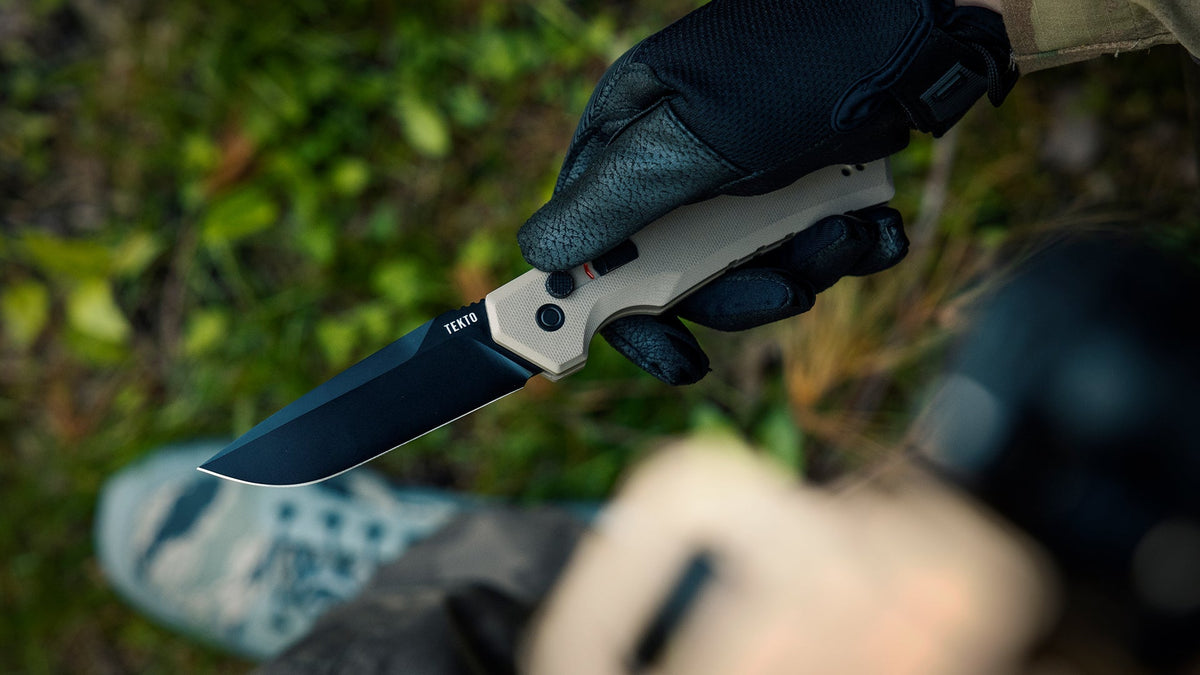
The spine runs in one unbroken convex curve from the handle down to a tip that sits below the spine line, with plenty of steel behind it. The lowered tip is easy to control and hard to break, and the long belly slices well, which is why the drop point is the default on hunting knives and modern folders and why TEKTO builds more drop points than anything else: the F2 Bravo, F3 Charlie, A3 Delta and A3 Delta Mini, the A5 Spry and A5 Spry Mini in Drop Point, and the X1 Atlas. If you are buying one knife and do not know which shape you want, this is the answer. Our clip point vs drop point guide covers the shape it replaced.
Tanto
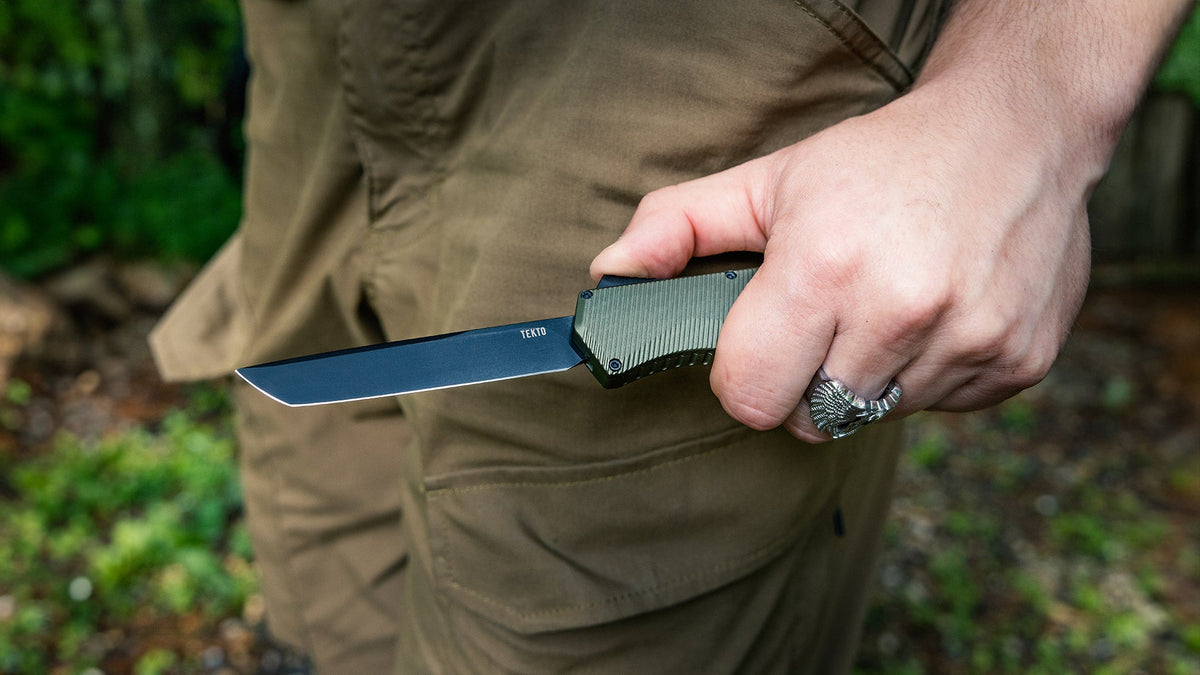
The tanto replaces the belly with a second straight edge that meets the main edge at an angle, so the blade has two cutting planes and a point backed by nearly the full thickness of the spine. It is the strongest tip you can put on a pocket knife: it pries staples, scores drywall, opens cans and pierces hard material without rolling. The price is slicing. With no belly, a tanto cuts in straight pushes rather than long draws, and it sharpens as two flats instead of one sweep. TEKTO offers it on the A2 Badger, the A5 Spry and A5 Spry Mini, and the F2 Bravo EOTECH Edition. Our tanto guide has the history, the geometry and the sharpening method.
Reverse Tanto
Take the tanto's angled corner and move it from the edge to the spine: the spine runs straight, then drops at an angle to a tip that sits low, while the edge keeps a gentle belly. The result keeps the tanto's thick, reinforced point and gives back most of the slicing the tanto gave up. The tip is lower than a tanto's, so it is easier to steer into a cut, and the long flat on the spine gives the thumb somewhere to press. The F4 Echo, our manual flipper designed with Zastava, carries a 3.40-inch reverse tanto in S35VN, and it is the shape to pick if you want tanto strength in a knife that still slices an apple.
Spear Point and Double Edge
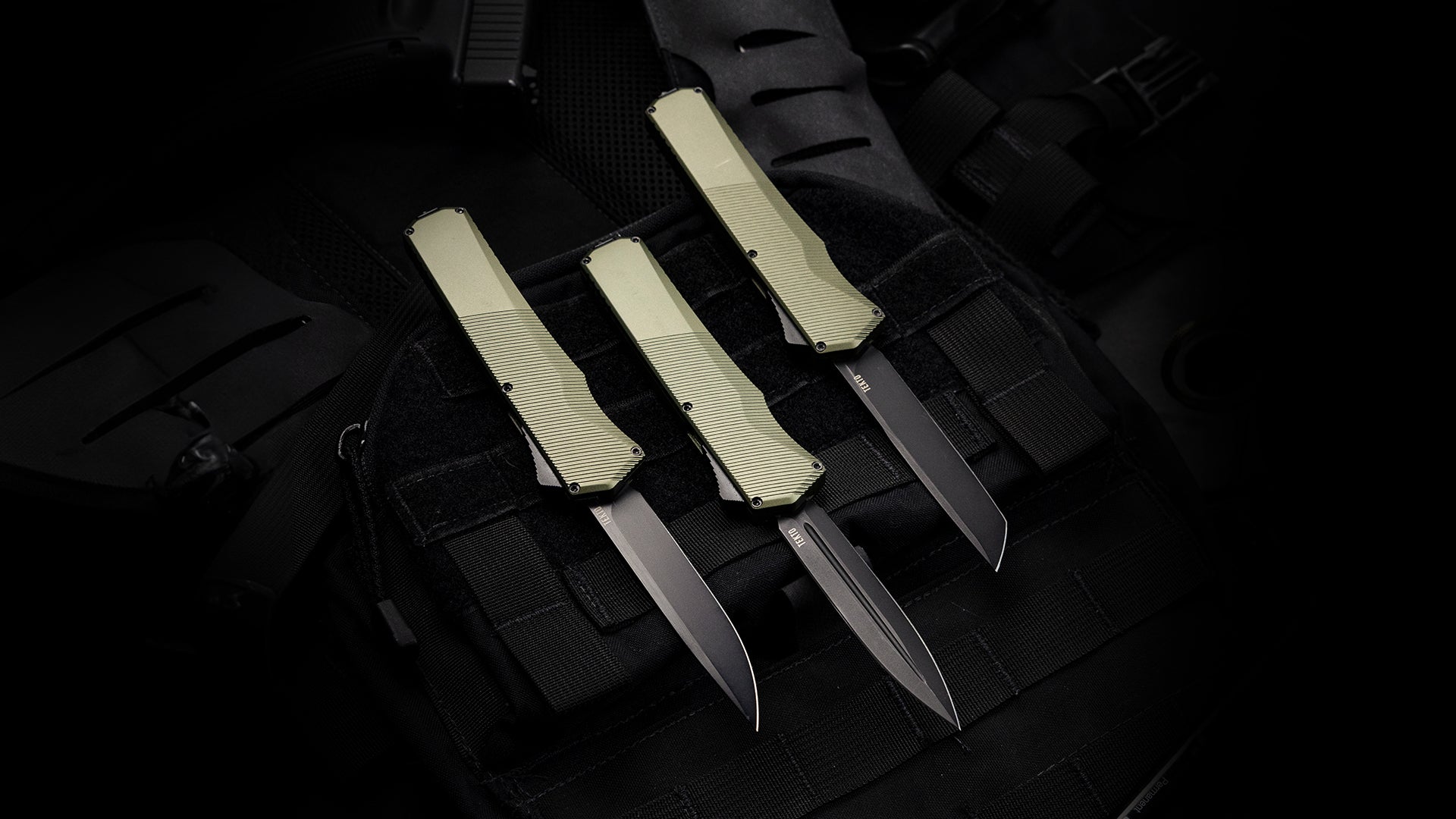
A spear point is symmetrical: spine and edge curve equally to a point on the centerline, like a drop point mirrored. The point is centered and pierces cleanly, with more steel behind it than a clip point. On a single-edge spear point only the lower side is sharpened and the upper is an unsharpened swedge. That is the A7 Zastava in Spear Point. Sharpen both sides and you have a double edge, also called a dagger blade, the classic OTF profile: the A2 Badger, A4 (with serrations), A5 Spry, A5 Spry Mini and A7 Zastava all offer it. A double edge pierces best of all and looks the part, and it carries two cautions: there is no safe spine to push on with a thumb, and a few states treat double-edged blades differently from other knives, which section 10 covers.
Straight Back
The oldest shape: a flat spine running straight to the tip, with the edge curving up to meet it. The point sits high, in line with the spine, so it is strong and the edge below it is long and nearly flat, which is what chefs, whittlers and anyone who cuts on a board want. The F1 Alpha carries a modified straight back, the straight spine with a slight lift at the tip, on a 3.10-inch D2 blade with a full flat grind, which makes it a fine slicer for a knife its size.
Shapes We Do Not Make
Four shapes show up in every blade-type list and none of them is in the TEKTO range, for reasons worth knowing. The clip point cuts away the spine near the tip for a fine, fast-piercing point that is also the easiest to snap. It is the Bowie and slipjoint classic, and we chose the drop point over it for tip strength. The sheepsfoot and its sharper cousin the wharncliffe put a straight edge under a spine that curves down to meet it, giving a blade with no point to speak of: superb for cutting cord and cardboard without stabbing what is behind it, and the reason rescue and rigging knives use them. The hawkbill curves the whole blade downward like a claw, which pulls material into the edge when you draw it. It is a carpet and rope cutter and little else. And the kukri, the Nepalese chopper with a forward-weighted bend, is a machete in knife form, superb at chopping and no use in a pocket. If you need one of those, buy one for the job. For everything else, the six above cover it.
Which Shape for Which Job
| Job | Shape | From TEKTO |
|---|---|---|
| One knife for everything | Drop point | F2 Bravo, A5 Spry Drop Point, A3 Delta |
| Boxes, straps and packaging all day | Tanto or reverse tanto | A5 Spry Tanto, F4 Echo |
| Prying, scraping, opening cans | Tanto | A2 Badger Tanto, A5 Spry Tanto |
| Food and camp cooking | Drop point or straight back | X1 Atlas, F1 Alpha |
| Hunting and skinning | Drop point | X1 Atlas, F3 Charlie |
| Clean piercing, centered point | Spear point or double edge | A7 Zastava, A5 Spry Double Edge |
| Whittling and cutting on a board | Straight back | F1 Alpha |
| Strong tip and a slicing belly at once | Reverse tanto | F4 Echo |
| Smallest legal carry in a strict state | Tanto (single edge) | A2 Badger Tanto, A5 Spry Mini Tanto |
Shape and the Law
Shape rarely matters to the law, with one exception: the double edge. A handful of states name daggers or double-edged blades in their statutes, usually as the knives that cannot be carried concealed, and a double-edge OTF is a dagger-shaped blade whatever it is called on the box. A tanto, drop point or spear point with one edge is an ordinary knife everywhere a knife is legal. If you live in a state with a dagger rule, or travel through one, buy the single-edge shape. Our 50-state OTF law guide and the state pages linked from it say which states those are. Blade length and opening mechanism matter far more to the law than shape, and the same guides cover both.
Sharpening by Shape
Every shape sharpens at the same angle, about 20 degrees per side on a TEKTO, and the difference is the stroke. A drop point, spear point and straight back sharpen in one continuous pass, heel to tip, following the belly around. The only trick is not lifting the spine as you reach the tip. A tanto and a reverse tanto sharpen as two flats: the main edge first, then the short second edge, each kept flat on the stone, with the corner between them left crisp rather than rounded. A double edge is two single edges. Sharpen one, flip, sharpen the other. Our sharpening guide walks through the stone, the rod and the strop, and our serrated vs plain edge guide covers the one edge that needs its own tool.
One of Each
The Spry in all three OTF shapes, the reverse tanto, the spear point and the straight back.


People Are Asking
What is the most popular knife blade shape?
The drop point, on folders, fixed blades and hunting knives alike, because its lowered, thick tip is hard to break and its long belly slices well. It is the shape most of the TEKTO range is built around.
What is the best blade shape for everyday carry?
A drop point for most people. If your day is boxes, straps and packaging, a tanto or reverse tanto. If it is food and camp, a drop point or straight back. The job decides the shape, and the table above matches them.
What is the difference between a tanto and a drop point?
A drop point has one curved edge that sweeps up to a lowered tip with belly for slicing. A tanto replaces the belly with a second straight edge meeting the first at an angle, which puts nearly the full spine thickness behind the point. Drop point for slicing, tanto for the strongest tip.
What is a reverse tanto?
A blade whose angled corner is on the spine instead of the edge: the spine runs straight then drops at an angle to a low tip, while the edge keeps a belly. It has a tanto's reinforced point and a slicing edge. The F4 Echo is TEKTO's reverse tanto.
What is a spear point blade?
A symmetrical blade where spine and edge curve equally to a point on the centerline. With one edge sharpened it is a spear point. With both, a double edge or dagger blade. The A7 Zastava comes in both.
Is a double edge blade better than a single edge?
It pierces better and looks sharper, and it gives up a safe spine to push on and is treated as a dagger in a few states. For cutting work a single edge is more useful. For a centered point with the least resistance, the double edge.
What blade shape is best for self-defense?
A knife is a cutting tool first, and this guide is about choosing one for work. On geometry alone, a double edge or spear point pierces most easily and a tanto resists breaking. The far bigger factors are a knife you can open and control, and local law. See our state knife law guides before you carry any blade for that reason.
What are the parts of a knife blade?
The spine (the unsharpened back), the edge, the belly (the curved part of the edge near the tip), the point, and the grind (how the blade thins from spine to edge). Shape is the outline. Grind is the cross-section. Our folding knife anatomy guide covers both.