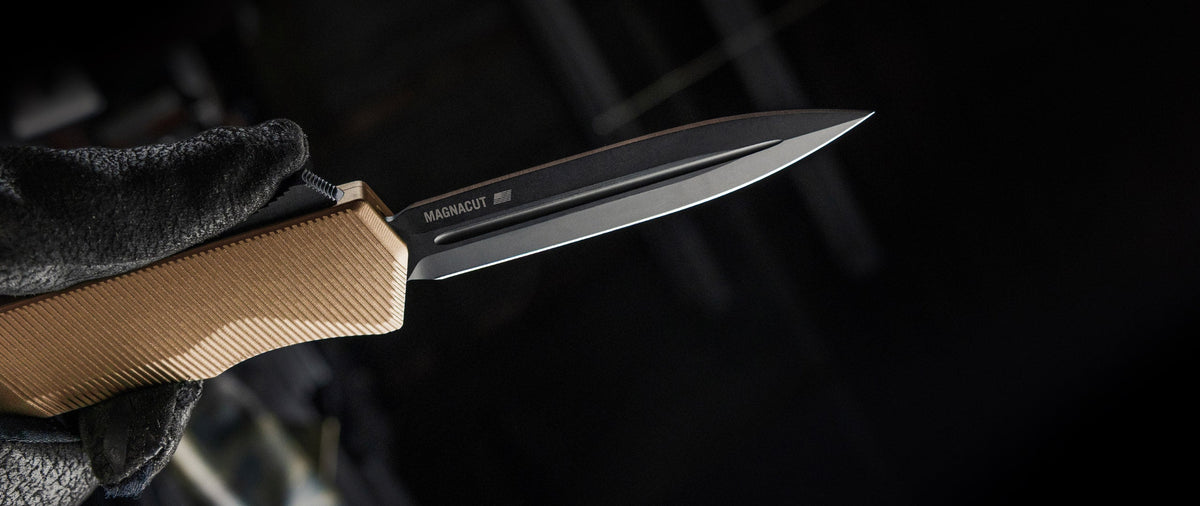
What D2 Steel Is
D2 is a high-carbon, high-chromium cold-work tool steel. It was developed for industrial dies and shear blades, where a hard edge that wears slowly matters more than anything else, and it moved into knives in the 1960s for the same reason. The recipe is about 1.5 percent carbon and 12 percent chromium, with around 1 percent each of molybdenum and vanadium. Those numbers put it in an unusual place: more carbon than almost any stainless steel, and enough chromium to be nearly stainless but not quite.
| Element | D2 | What it does |
|---|---|---|
| Carbon | 1.4 to 1.6% | Hardness and the carbides that resist wear |
| Chromium | 11 to 13% | Corrosion resistance and chromium carbides |
| Molybdenum | 0.7 to 1.2% | Hardenability and strength |
| Vanadium | 0.5 to 1.1% | Finer grain and harder carbides |
Hardness
D2 is air-hardening, which means it reaches full hardness without a water or oil quench, and it holds a heat treatment well. Knife blades in D2 run between 58 and 62 HRC on the Rockwell C scale. TEKTO's D2 blades are finished at 58 to 60 HRC on the OTFs and 60 to 62 on the A3 Delta and F3 Charlie, where the thicker blade can take the extra hardness without becoming brittle. For comparison, most budget stainless blades sit at 55 to 58, and a kitchen knife at 56 or so. Hardness is what lets a steel take and hold a fine edge. Past a point it also makes the steel easier to chip, which is why the number is a choice rather than a race.
Edge Retention
This is what D2 is for. The carbon and chromium form large, hard chromium carbides in the steel, and those carbides are what the edge is cutting with long after a softer steel would have rolled or dulled. In practice a D2 blade stays usable through far more cardboard, rope and cord than 440C, 8Cr13MoV or AUS-8, and it is in the same conversation as steels that cost twice as much. The edge it takes is slightly toothy rather than glassy, which is an advantage on fibrous material and no disadvantage anywhere else.
Toughness
The same large carbides that hold the edge make D2 less tough than a steel made for impact. Toughness is a steel's resistance to chipping and cracking, and D2 is average at best: fine for every cutting task, not the right choice for prying, batoning or twisting the tip in something hard. That is why D2 is at home in folders and OTFs, where the blade is used for cutting, and why TEKTO's fixed blade, the X1 Atlas, is made from MagnaCut instead.
Rust: Semi-Stainless, and What the Coating Does
Stainless steel needs roughly 12 percent chromium free in the steel to form its protective oxide layer. D2 has 12 percent chromium, but a large share of it is locked up in the carbides from section 03, so less is left to protect the surface. The result is a steel that resists rust far better than a true carbon steel like 1095 and worse than a true stainless like 14C28N. Left wet, especially in salt air, it will spot.
TEKTO's D2 blades carry a titanium coating. The coating seals the flats and the spine from moisture, which removes most of the risk in daily carry. The edge itself is bare steel, because an edge has to be. It is the part that gets wiped dry and oiled.
D2 Against the Stainless Steels
The comparison people search for most is D2 against a stainless blade, and the answer depends on which stainless. Against 440C and 8Cr13MoV, the steels in most knives under a hundred dollars, D2 holds an edge noticeably longer and gives up a little rust resistance. Against 14C28N, a modern Swedish stainless, D2 still wins on edge life and loses clearly on corrosion resistance and toughness. If you cut a lot and wipe your knife, D2. If you fish, sweat on it or forget it in a wet pocket, the stainless.
D2 Against S35VN and MagnaCut
S35VN and MagnaCut are powder-metallurgy steels: the carbides are smaller and spread evenly, which gives them toughness and corrosion resistance D2 cannot match. S35VN holds an edge about as long as D2, is fully stainless, and sharpens a little more easily. It costs more to buy and to machine. MagnaCut keeps the edge retention, adds toughness that no other stainless in its class has, and shrugs off salt water. That is the steel on the X1 Atlas and the A5 Spry Bronze Edition. D2 is the working steel in the range. The two powder steels are the upgrades. Our MagnaCut guide goes deeper on the top of the range.
| D2 | 440C | 14C28N | S35VN | MagnaCut | |
|---|---|---|---|---|---|
| Type | Tool steel | Stainless | Stainless | Powder stainless | Powder stainless |
| Typical knife hardness | 58 to 62 | 56 to 59 | 58 to 61 | 59 to 61 | 60 to 64 |
| Edge retention | High | Medium | Medium | High | High |
| Toughness | Medium-low | Medium | High | Medium-high | Very high |
| Rust resistance | Medium (semi-stainless) | High | High | High | Very high |
| Sharpening | Slow | Easy | Easy | Medium | Medium |
| Price tier | Value | Value | Value | Premium | Premium |
| TEKTO models | F1, F2, F3, A2, A3, A4 | None | None | A5, A5 Mini, A7, F4 | X1 Atlas, A5 Bronze |
Sharpening D2
D2 sharpens slowly because the carbides are harder than most sharpening stones. A diamond plate or a ceramic rod cuts it cleanly. A soft Arkansas stone will polish the steel around the carbides and take a long time to raise a burr. Keep the angle where the factory put it, 20 degrees per side on TEKTO blades, and touch the edge up on a ceramic rod before it gets dull rather than regrinding it after. Our sharpening guide covers the method.
Caring for D2 in Wet Conditions
D2 needs one habit: dry it. After rain, sweat, saltwater or a wet job, wipe the blade and the handle, open and closed, and let the knife air out before it goes back in a pocket or a pouch. Once a month, or after any day on the water, put a drop of light knife oil on the blade and the pivot and wipe off the excess. For an OTF, run the blade out, wipe the track, and oil where the blade enters the handle. The OTF care guide has the full routine.
Never store a D2 knife in a leather sheath or a closed damp case. If you fish or work on boats every day, choose S35VN or MagnaCut and skip the worry.
Which TEKTO Knives Use D2
Six of the range: the F1 Alpha, F2 Bravo and F3 Charlie folders, the A3 Delta side-opening automatic in both sizes, and the A2 Badger and A4 OTFs. All carry the titanium coating. The A5 Spry, A5 Spry Mini, A7 Zastava and F4 Echo move up to S35VN, and the X1 Atlas and the A5 Spry Bronze Edition use MagnaCut.
Made of D2
Two folders, a side-opening automatic and an OTF, all with titanium-coated D2 blades.


People Are Asking
Is D2 a good knife steel?
Yes, for a knife that cuts. It holds an edge longer than almost any stainless steel at its price and takes a hard, durable heat treatment. Its limits are toughness, so no prying, and rust, so wipe it dry.
Does D2 hold an edge?
That is its best quality. The chromium carbides in the steel keep cutting long after softer steels have dulled, which is why it came from the tool-and-die world in the first place.
What are the downsides of D2 steel?
Three. It is not fully stainless, so it can spot if left wet. It is less tough than steels made for impact, so it can chip under prying. And it is slow to sharpen on ordinary stones. Use diamond or ceramic.
Is D2 stainless?
Not quite. It has about 12 percent chromium, but much of it is tied up in carbides, so it is called semi-stainless: far more rust-resistant than carbon steel, less than a true stainless. A coating, like the titanium coating on TEKTO's D2 blades, covers most of the gap.
D2 vs S35VN: which is better?
S35VN is fully stainless, tougher and a little easier to sharpen, with similar edge retention. It costs more. D2 gives you most of the edge life for less money and asks you to keep it dry. Both are good choices. The right one depends on where you carry.
D2 vs S30V: what is the difference?
S30V is the older sibling of S35VN: a powder stainless with slightly better edge retention than D2, better rust resistance and a reputation for chipping that S35VN was designed to fix. Against D2 the trade is the same as with S35VN: stainless and tougher for more money.
What knives use D2 steel?
Many working folders and OTFs. At TEKTO, the F1 Alpha, F2 Bravo, F3 Charlie, A3 Delta, A2 Badger and A4 all carry titanium-coated D2 blades.
What is the hardest steel to sharpen?
Among common knife steels, the high-vanadium powder steels such as S90V and Maxamet, which need diamond stones. D2 is slower than stainless but well short of those. A ceramic rod keeps it sharp without trouble.