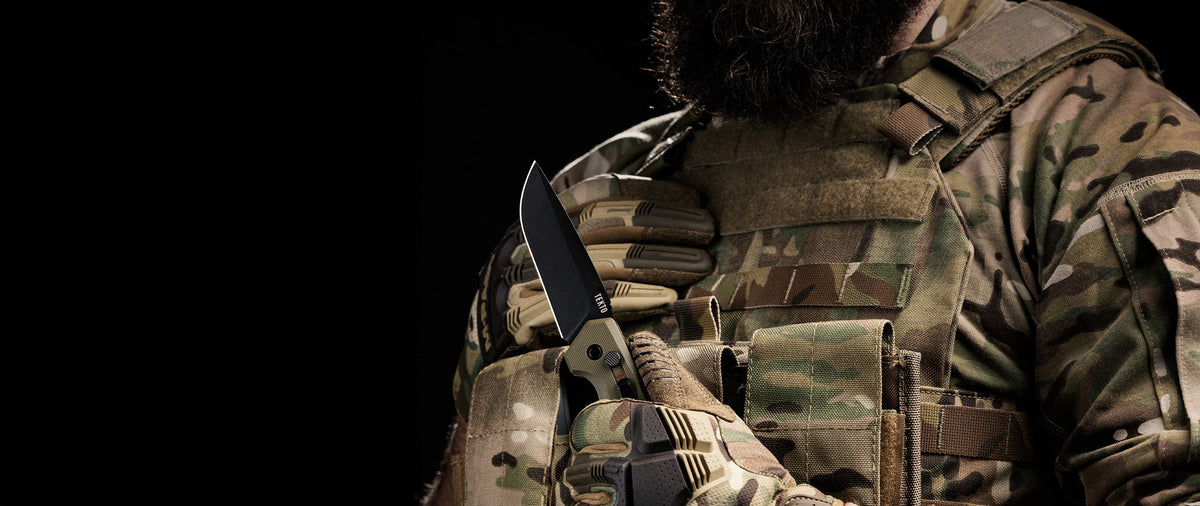
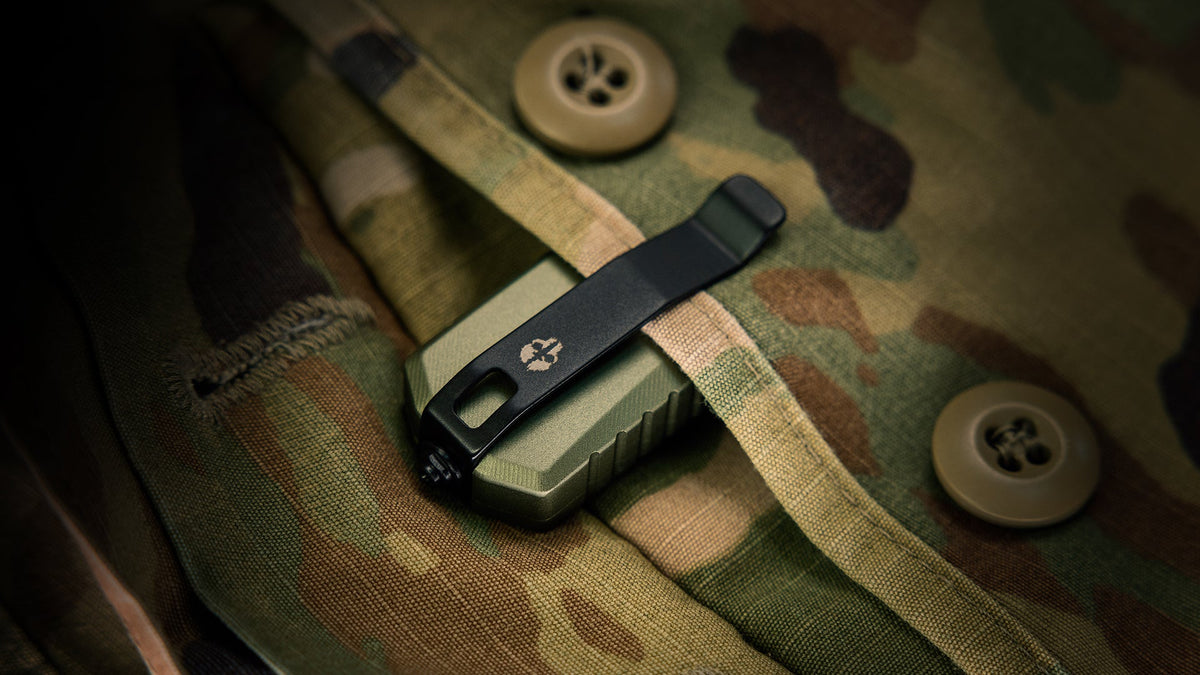
A glove takes away two things a knife relies on: feel, and fine motor control. The knife has to give them back. That means an opener you can find without looking, a handle that holds a wet leather palm, and a blade that comes out and goes away with one hand. Two TEKTO knives fit that brief particularly well: the side-opening automatic A3 Delta and the folding F3 Charlie.
The A3 Delta: The Working Automatic
The A3 Delta earns its place in a glove on the handle first. The scales are textured and contoured so the knife stays put in a hand that cannot feel it well, whether the glove is wet from weather or thick against the cold, and the shape gives a full grip rather than a pinch.
The opener is the second reason. The Delta is a button-fired automatic with a large button positioned where the thumb lands, so the blade comes out with a press that works through a glove, and the safety keeps it from firing in a pocket. There is no stud to find and no flipper to catch. When the work is done, the same button releases the lock and the blade folds home.
At 3.60 inches of D2 and just under 6 ounces, it is the heavier of the two, and that weight settles the knife in the hand over a long job. For cold-weather work, farm chores and anything done in leather, it is the one we would reach for.
The F3 Charlie: The Lighter Folder
The F3 Charlie gives up the automatic deployment and keeps most of the advantages. It opens one-handed and locks with a button lock, which also means one-handed closing, a detail that matters more in gloves than it sounds: no pinching a liner, no fumbling a lock bar.
The handle is the other half. The scales carry texture and a shape that fills the hand, so the knife stays controlled in a work glove or an insulated one, and the 3.80-inch blade gives reach for cutting cord, straps and packaging without choking up on it.
Over a long day the contouring pays off. No hot spots, a grip that does not need to be reset, and a lighter knife than the Delta for the pocket. Where automatics are not legal, it is the answer.
What to Check on Any Knife
Whichever knife you consider, put a glove on and try three things: open it without looking at it, close it with the same hand, and hold it blade-down with a wet palm. If any of those fails, it is not the knife for gloves, however good it is bare-handed. For thick or insulated gloves, consider skipping the opener entirely: a fixed blade such as the X1 Atlas draws and cuts with nothing to operate. And for the pocket, our guide to the best way to carry a knife covers clips, pouches and lanyards that make a gloved draw easier.
Knives That Work in Gloves
The two picks, the one-thumb OTF, and the fixed blade for when the gloves are insulated.


People Are Asking
What makes a knife good for gloved hands?
Three things: an opener you can work without feeling it (a large button, a thumb stud with a lip, or an OTF slider), a handle with texture and a finger guard so a wet glove does not slide onto the edge, and a lock you can release with the same hand. Small, smooth, flipper-only knives are the ones that fight gloves.
Is an automatic knife better with gloves?
Usually. A button or a slider is easier to find through a glove than a thumb stud, and the blade does the opening. The A3 Delta's button and the A5 Spry's slider both work with the thumb alone. Check that automatics are legal where you live first.
Can I use a fixed blade with gloves?
A fixed blade is the simplest answer for thick or insulated gloves, because there is nothing to open: draw and cut. The X1 Atlas in its Kydex sheath is the TEKTO knife for that, with a handle shaped for a full-hand grip.
Does the blade steel matter for gloved work?
Not for grip, but for the conditions that put you in gloves: wet, cold, salt and dirt. The A3 Delta runs D2 tool steel, which wants a film of oil in wet work. The X1 Atlas runs MagnaCut, which shrugs it off.