The Short Version
Edge retention, toughness, corrosion resistance, ease of sharpening: pick the two you care about and accept the other two. D2 is edge retention and price, with a coating standing in for corrosion resistance. S35VN is a balanced stainless that sharpens easily. MagnaCut is the first stainless that is as tough as a tool steel. Heat treatment and edge geometry matter as much as the name. A sharp knife in any of them beats a dull knife in the best of them. In the TEKTO line, the A5 Spry, A5 Spry Mini, A7 Zastava and F4 Echo run S35VN, the X1 Atlas and the A5 Spry Bronze Edition run MagnaCut, and the F1 Alpha, F2 Bravo, F3 Charlie, A2 Badger, A3 Delta and A4 run titanium-coated D2.
Steel names on a blade are a shorthand for a recipe and a promise about how the recipe was cooked, and most of what is written about them is marketing. This guide is the part that is not. It starts with what steel is and why adding things to it helps and hurts, explains the four properties every knife owner actually notices, covers hardness and heat treatment, which are where the makers earn or lose the recipe's potential, and then puts the three steels in the TEKTO line side by side with their compositions and their care. The D2 guide and the MagnaCut guide go deeper on each. This is the page that explains how to read them.
What Blade Steel Is
Steel is iron with a small amount of carbon, and a blade steel is that plus a handful of other elements chosen to change how it behaves. Carbon is what lets steel harden: heat it, quench it, and the carbon locks the iron into a hard structure called martensite. Chromium does two things, and the amount decides which: at a few percent it helps hardening and forms hard carbides. At about 12 percent and up, enough of it stays dissolved in the iron to form the invisible oxide skin that makes a steel stainless. Vanadium, niobium, molybdenum and tungsten form carbides, which are tiny particles far harder than the steel around them and the main reason a blade resists wear. Nitrogen can stand in for some carbon and improves corrosion resistance. Manganese, silicon and the rest are there for the mill, not the knife.
The catch is that carbides, which give edge retention, also give brittleness, and chromium tied up in carbides is chromium not protecting against rust. Every steel is a decision about how much of each to add and in what form, and the decision has consequences you can feel on a stone and see on a blade left wet overnight.
The Four Properties, and Why They Fight
Edge retention is how long the blade keeps cutting before it needs the stone, and it comes from hardness and from carbide volume: harder steel resists the edge rolling over, and carbides resist it wearing away. Toughness is the ability to bend and absorb a shock without chipping or cracking, and it falls as hardness and carbide volume rise, which is why the steels with the best edge retention chip on a staple and the toughest steels dull on cardboard. Corrosion resistance comes from free chromium, and nothing else, which is why a tool steel with 12 percent chromium locked in carbides rusts and a stainless with 14 percent free chromium does not. Ease of sharpening is the inverse of wear resistance: the carbides that keep the edge are the carbides your stone has to cut through, and a steel heavy in vanadium carbide wants diamond or ceramic rather than a soft water stone.
So a steel maker who wants edge retention adds carbon and vanadium, and pays in toughness and sharpening. One who wants a stainless adds chromium, and pays in toughness because chromium carbides are large. One who wants toughness lowers the carbide volume, and pays in edge retention. For eighty years the answer was to pick your compromise. The last twenty years changed what was possible, which is the next section.
Hardness, Heat Treatment and Why the Name Is Not Enough
Hardness is measured on the Rockwell C scale, HRC, and most knife blades run between 57 and 64. A point or two matters: 58 HRC resists rolling noticeably less than 61, and 63 chips noticeably more than 61 in the same steel. The number is set by the heat treatment, the cycle of heating, quenching and tempering that the maker runs, and the same steel can be made soft and tough or hard and brittle depending on how it is done. This is the part the name on the blade does not tell you, and it is why two knives in the same steel from two makers can behave differently. TEKTO runs its coated D2 at 58 to 60 HRC in the folders and the Badger and at 60 to 62 in the Delta and Charlie, its S35VN at 60 to 62 in the Spry, Spry Mini and Echo and 58 to 61 in the Zastava, and its MagnaCut at 60 to 62 in the Atlas and 62 to 64 in the Spry Bronze Edition. Those numbers are on each product page, which is where to look when a maker does not state them.
Edge geometry is the other thing the name hides. A blade ground thin behind the edge cuts better in any steel than a thick one in a better steel, and a 20-degree edge is tougher than a 15-degree edge in the same steel. TEKTO grinds at about 20 degrees per side, which is the general-purpose angle. The sharpening guide explains how to keep it.
Conventional Steel and Powder Metallurgy
In a conventional steel the carbides form as the molten ingot cools, and in a high-alloy steel they grow large and clump along the grain, which makes the steel harder to grind, less tough and prone to chipping at the edge. Powder metallurgy, which Crucible's CPM process brought to knife steels in the 1990s, atomizes the molten steel into a fine powder, so that each particle solidifies in an instant with tiny, evenly spread carbides, then presses the powder solid under heat. The result is a steel of the same recipe that is tougher, finer grained, more uniform and easier to finish. It is why a modern powder stainless can carry more vanadium than a 1950s stainless could and still be tough, and it is the difference between D2, a 1930s conventional steel, and S35VN and MagnaCut, which exist only because of the process. CPM in a steel's name means powder metallurgy, so do the names of the other mills' processes, such as Böhler's Microclean. The knife history page puts it in the longer story.
D2: The Tool Steel That Became a Knife Steel
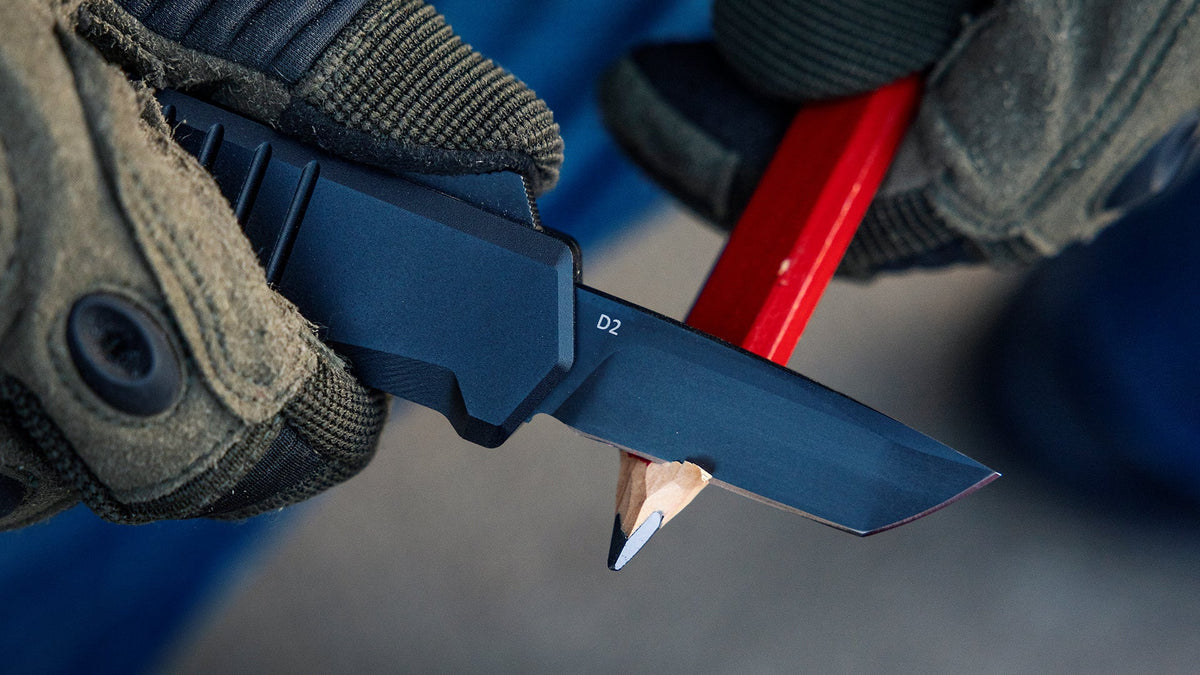
D2 is an air-hardening cold-work tool steel from the 1930s, made for industrial dies that stamp and cut other steel, and it was adopted by knife makers because it holds an edge far longer than its price suggests. It carries about 1.5 percent carbon, 12 percent chromium, a percent of molybdenum and a percent of vanadium, which gives it high hardness and a large volume of chromium carbides. Those carbides are why it wears so slowly, and they are also why it is not stainless: enough chromium is tied up in them that the free chromium falls short of the 12 percent or so a steel needs to protect itself. D2 will spot and stain if left wet, which is why TEKTO coats its D2 blades in titanium, which protects the flats. The edge, where the coating is ground away, wants a wipe and a drop of oil. Its toughness is modest, so a thin D2 edge can chip on hard use, and its carbides make it slower to sharpen than a plain carbon steel. For a folder or a small automatic that cuts cardboard, cord and food and gets wiped at the end of the day, it is a good steel at a good price, which is why it is in the F1 Alpha, F2 Bravo, F3 Charlie, A2 Badger, A3 Delta and A4. The D2 guide goes deeper.
CPM S35VN: The Balanced Stainless
S35VN was introduced by Crucible in 2009 as a refinement of S30V, the first steel designed specifically for knives. It carries about 1.4 percent carbon, 14 percent chromium, 2 percent molybdenum, 3 percent vanadium and half a percent of niobium, and the niobium is the point: niobium carbides are small, hard and form at the expense of the large chromium carbides, so the steel is tougher and finer grained than S30V, easier to grind and sharpen, and leaves more chromium free for corrosion resistance. It is fully stainless, it takes a fine edge, it holds that edge well without being stubborn on a stone, and it runs happily at 60 to 62 HRC. It is the steel most custom makers reached for through the 2010s and the one in the A5 Spry, A5 Spry Mini, A7 Zastava and F4 Echo. If you want one steel for a knife you will use daily and sharpen yourself, S35VN is the safe choice.
CPM MagnaCut: The Stainless That Is as Tough as a Tool Steel
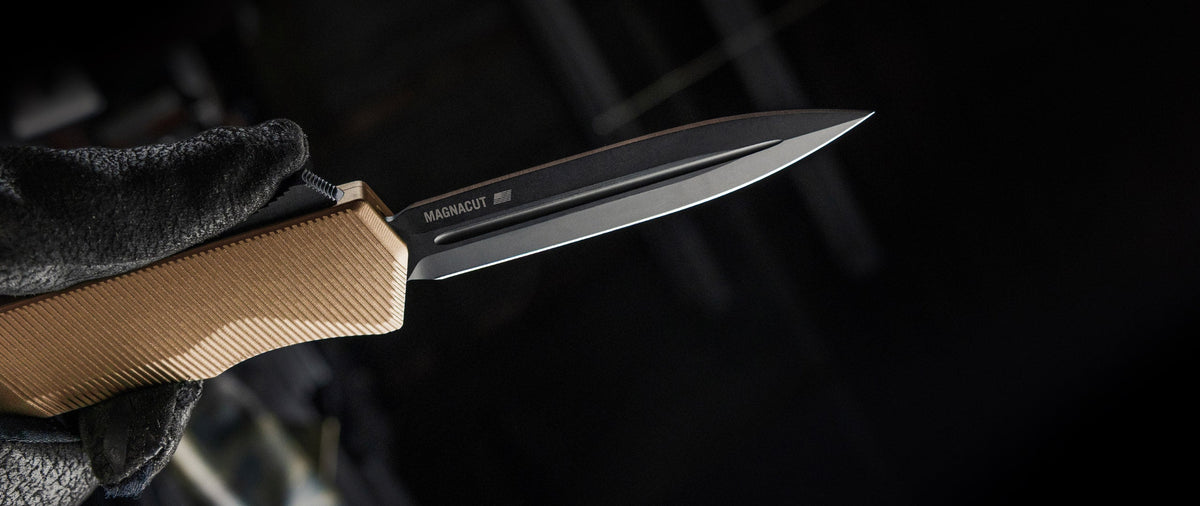
MagnaCut was designed by the metallurgist Larrin Thomas and released by Crucible in 2021, and it rebalanced the recipe in a way no one had managed before. Its chromium is low for a stainless, about 10.7 percent, but its carbon is held down to about 1.15 percent with 0.2 percent nitrogen in support, so that almost no chromium carbides form at all. Nearly all of the chromium stays in solution protecting against rust, and the carbides that give edge retention are vanadium and niobium carbides, 4 and 2 percent, which are small and hard. The result is a steel with the corrosion resistance of a good stainless, the toughness of a non-stainless tool steel like CPM-4V, and edge retention close to S35VN's, at hardnesses up to 64 HRC. It is the first steel that does not make you choose between stainless and tough, which is why it went from release to the most talked-about knife steel in a year. It is the steel in the X1 Atlas, a fixed blade that is asked to do everything a field knife does in blood, salt and cold, and in the Spry Bronze Edition. The MagnaCut guide covers it in detail.
The Three Steels Side by Side
| D2 (titanium coated) | CPM S35VN | CPM MagnaCut | |
|---|---|---|---|
| Type | Conventional tool steel, 1930s | Powder stainless, 2009 | Powder stainless, 2021 |
| Composition, approx. | 1.5 C, 12 Cr, 1 Mo, 1 V | 1.4 C, 14 Cr, 2 Mo, 3 V, 0.5 Nb | 1.15 C, 10.7 Cr, 2 Mo, 4 V, 2 Nb, 0.2 N |
| Stainless | No. The coating protects the flats | Yes | Yes |
| Edge retention | High | High | High |
| Toughness | Moderate | Good | Very high for a stainless |
| Corrosion resistance | Low (coated) | Good | Very good |
| Sharpening | Slow on soft stones. Use diamond or ceramic | Easy for its class | Moderate. Diamond or ceramic preferred at high hardness |
| TEKTO hardness | 58 to 62 HRC | 58 to 62 HRC | 60 to 64 HRC |
| TEKTO knives | F1, F2, F3, A2 Badger, A3 Delta, A4 | A5 Spry, Spry Mini, A7 Zastava, F4 Echo | X1 Atlas, Spry Bronze Edition |
Which Steel, by What You Do
For a pocket folder or a small automatic that cuts cardboard, cord, tags and lunch and gets wiped at night, coated D2 does the job and saves money. S35VN does it with no rust to think about and an easier edge to maintain. For a knife that gets wet, in a kitchen, on a boat, in a sweaty pocket in July, a stainless, and of the two, MagnaCut if the budget allows. For a knife that works hard outdoors, dressing game, splitting kindling, prying a little when you should not, MagnaCut is the steel designed for exactly that, which is why it is in the Atlas. For a knife you will sharpen often yourself, S35VN is the most forgiving of the three. And for a knife you will carry for a decade, any of them, kept sharp and dry, because the care below matters more than the choice above.
Care, by Steel
- All three. Wipe the blade after use, dry it before it goes in the pocket, and touch up the edge before it is dull rather than after. Store it dry. The maintenance guide covers the routine.
- D2. Treat it as a carbon steel at the edge: a drop of oil on the exposed steel after wet work, and never leave it wet overnight. The titanium coating on the flats needs nothing. Sharpen on diamond or ceramic. A soft water stone will be slow.
- S35VN. Rinse, dry, done. It sharpens on any decent stone and responds well to a ceramic rod for touch-ups.
- MagnaCut. Rinse, dry, done, and salt water is survivable with a rinse. At 62 to 64 HRC it wants a diamond plate or a hard ceramic for sharpening and rewards a light touch.
Whatever the steel, the sharpening guide is the page that keeps it a knife, and the OTF buying guide says what the steel means inside an automatic, where the blade lives in a handle that collects moisture.
One Knife in Each Steel
MagnaCut in the Atlas, S35VN in the Spry, coated D2 in the Bravo and the Badger.


People Are Asking
What is the best knife steel?
There is no best, only the best trade for your use. For a stainless that is as tough as a tool steel, CPM MagnaCut. For a balanced stainless that sharpens easily, CPM S35VN. For edge retention at a lower price, coated D2.
Is D2 steel good for knives?
Yes. It holds an edge very well and costs less than the powder stainless steels. It is not stainless, so it is coated and wants to be kept dry and oiled at the edge, and it is slower to sharpen on soft stones.
Is D2 stainless?
No. It has about 12 percent chromium, but enough is tied up in carbides that the free chromium falls short of what a stainless needs. It will stain if left wet.
What is the difference between S35VN and MagnaCut?
S35VN is a balanced powder stainless from 2009 that sharpens easily and holds an edge well. MagnaCut, from 2021, keeps nearly all its chromium free for corrosion resistance and gets its edge retention from vanadium and niobium carbides, so it is far tougher at the same hardness. Both are stainless.
What does CPM mean?
Crucible Particle Metallurgy, the powder metallurgy process that produces fine, evenly spread carbides. S35VN and MagnaCut are CPM steels. D2 is a conventional steel.
What hardness are TEKTO blades?
Coated D2 at 58 to 60 HRC in the folders and Badger and 60 to 62 in the Delta and Charlie. S35VN at 60 to 62 (58 to 61 in the Zastava). MagnaCut at 60 to 62 in the Atlas and 62 to 64 in the Spry Bronze Edition. Each product page lists its own.
Which steel is easiest to sharpen?
Of the three, S35VN. D2 and MagnaCut both prefer diamond or ceramic abrasives. A soft water stone is slow on either.
Does a better steel make a sharper knife?
No. Sharpness comes from the edge geometry and the sharpening. The steel decides how long the edge lasts, how it resists chipping and rust, and how it sharpens. A thin edge in D2 outcuts a thick edge in MagnaCut.