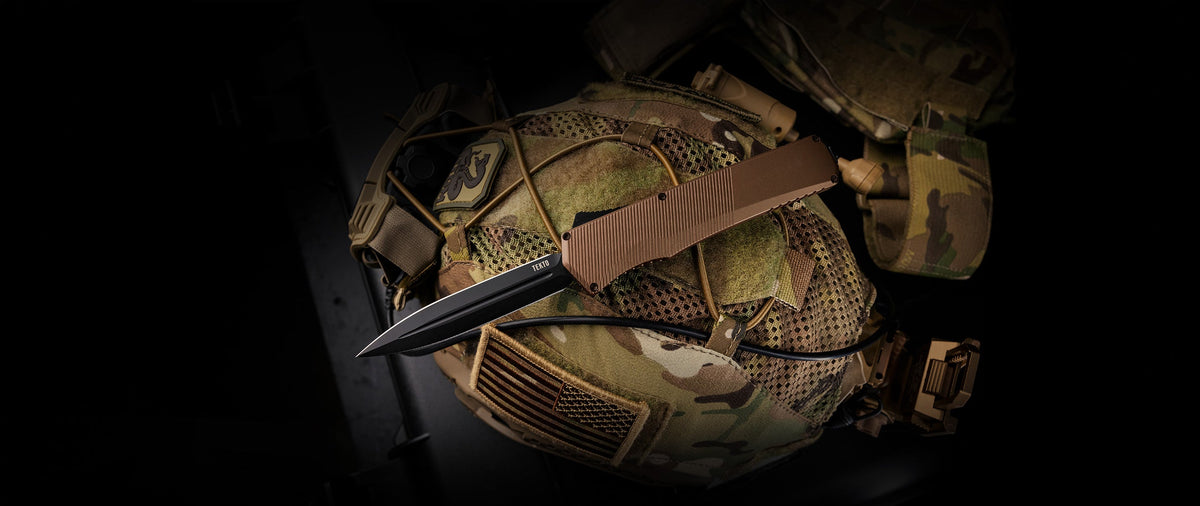
The Short Version
Double action. Under 2 inches if you are in California or want a keychain knife, 3.5 inches for most daily carry. Drop point unless you have a reason. S35VN or MagnaCut if the budget allows, coated D2 if it does not. A 6061 aluminum handle. Firm lockup with no blade play, a slider that resets itself, and a maker who will service it. Check your state before you order. Then buy the one you will carry every day, which for most people is the smaller one. In the TEKTO line that is the A5 Spry at 3.5 inches or the A5 Spry Mini at 1.85, and every TEKTO OTF is priced between $139.99 and $299.99.
An OTF, out-the-front, is an automatic knife whose blade travels straight out of the handle on a track instead of swinging out from the side. It is the one-hand knife for people whose other hand is busy, and it is also the knife category with the widest range in price and quality, because the mechanism is the product. A side-opening folder with a weak lock is a bad knife. An OTF with a weak mechanism is a knife that misfires, rattles and eventually fails to lock. This guide is about telling the difference before you pay, and about matching the knife to your hand, your state and your week. The OTF explained guide covers how the mechanism works. Start there if the words slider and carriage are new.
Double Action or Single Action
A double-action OTF fires the blade out and pulls it back with the same slider, and the mechanism resets itself every time. A single-action OTF fires on a button and is retracted by hand with a charging handle or slider. Double action is the modern standard and the one to buy. It is faster to close, which matters more than it sounds when you are putting the knife away one-handed, and it has the safety feature that defines the category: if the blade meets resistance on the way out, it disengages from the carriage rather than forcing through, which is why an OTF cannot be fired into something and why a blade that has "slipped" is reset by pulling it out by hand. Single action fires harder and locks up stiffer, which is why some fixed-blade people like it, but the two-step close and the stronger spring make it a worse daily knife. Every TEKTO OTF is double action. The types of switchblades guide sorts the rest of the mechanisms, including the side-opening automatic, which the A3 Delta is.
Blade Length: 1.85, 3.5 or 3.8 Inches
Length decides three things: the law, the handle and the job. The law first, because it can end the conversation. California bars carrying or selling an automatic with a blade of 2 inches or more, Connecticut draws its line at 1.5 inches, and a dozen states limit concealed carry of any knife by length. The 50-state guide has every line. That is why the 1.85-inch OTF exists as a category and why the A2 Badger and A5 Spry Mini are the knives for California and for anyone who wants an automatic on a keychain. The handle follows the blade: a 1.85-inch blade rides in a 3.2-inch handle at just over 2 ounces, a 3.5-inch blade in a 4.9-inch handle at about 3.5 ounces. And the job: 1.85 inches opens boxes, cuts cord and tags and does everything a pocket knife does in a city. 3.5 inches adds food, rope, leather and the work of a job site. 3.8 inches, the A4, is a work knife that happens to be an automatic. The OTF blade length guide goes deeper, and the practical rule is that the knife you carry is the one that disappears in the pocket, which is the shorter one more often than people expect.
Blade Shape: Drop Point, Tanto or Double Edge
Three shapes cover the OTF market. The drop point, with a convex spine curving down to a point roughly on the centerline and a long belly, is the all-purpose shape, the best slicer and the easiest to sharpen. It is the default for a reason and the one to pick if you are not sure. The tanto, with a flat main edge meeting a short second edge at an angle, puts a thick, strong point on the blade at the cost of the belly, which makes it better for piercing and scraping and worse for slicing, and it is the shape for anyone who uses the tip hard. The double edge, sharpened on both sides to a spear point, is the classic OTF profile and the symmetrical one. It pierces best of the three, slices well, and is the hardest to sharpen and the one most often restricted by law, since a double-edged blade is a dagger in several states regardless of mechanism. The A5 Spry comes in all three, the A7 Zastava comes as a 3.6-inch double edge or spear point, and the blade shapes guide draws each one. Serrations are a separate question. The A4 carries a double-edge serrated blade for rope and webbing, and the serrated vs plain guide says when that is worth it.
Steel: D2, S35VN or MagnaCut
The blade steel decides how long the edge lasts, how it resists rust and how it sharpens, and in an OTF, where the blade lives inside a handle that collects lint and moisture, corrosion resistance matters more than it does in a folder. D2 is a high-carbon tool steel with just under the chromium it needs to be stainless. It holds an edge very well and is the steel in the Badger and the Delta, coated to make up for the corrosion resistance it lacks. CPM S35VN is a powder stainless steel with niobium carbides that is fine grained, tough for its wear resistance and easy to bring back on a stone. It is the steel in the Spry and the Spry Mini. CPM MagnaCut, released in 2021, is a powder stainless designed to combine high toughness with stainless corrosion resistance and good edge retention, and it is the steel in the Spry Bronze Edition. The ranking for an OTF is MagnaCut, then S35VN, then coated D2, and the plain advice is that the difference between them is smaller than the difference between a sharp knife and a dull one. The blade steel guide has the compositions, the hardness ranges and the care for each.
| Steel | Type | Strengths | Watch for | TEKTO OTFs |
|---|---|---|---|---|
| D2, titanium coated | High-carbon tool steel | Edge retention, hardness, price | Not fully stainless. Keep it dry and oiled. The coating protects the flats | A2 Badger, A4, A3 Delta (side-opener) |
| CPM S35VN | Powder stainless | Fine grain, toughness, easy to sharpen, stainless | Costs more than D2 | A5 Spry, A5 Spry Mini, A7 Zastava |
| CPM MagnaCut | Powder stainless | Toughness of a tool steel with stainless corrosion resistance | Premium price. Run hard, so use a good stone | A5 Spry Bronze Edition |
Handle, Weight and Hardware
Nearly every serious OTF handle is 6061-T6 aluminum, machined, anodized and sometimes inlaid, because the handle has to hold a track straight under spring load for years and aluminum does that at a weight the pocket will tolerate. What varies is the machining: how precisely the two halves meet, whether the blade channel is cut cleanly, whether the hardware is steel or something softer. The things to look for are a seam you cannot feel, a slider that moves in one plane without wobble, screws that take a proper driver, and a pocket clip that is steel, not stamped aluminum. Weight follows length: just over 2 ounces for a 1.85-inch knife, about 3.5 for a 3.5-inch, and anything over 4 ounces, like the 5.4-ounce A4, is a work knife rather than a pocket knife. Extras worth having are a glass breaker, which the Badger and the Spry Mini carry, a lanyard hole, and an ambidextrous clip. Extras to be suspicious of are anything that adds weight without a job. The knife weight guide is about what the ounces mean in the hand.
What a Good Mechanism Feels Like
This is the part no spec sheet shows and the part that decides whether the knife is still working in five years. In the hand:
- Lockup. With the blade out, push the tip side to side and up and down. A good OTF has a little play, because a blade on a track cannot be as rigid as a pivot. A bad one rattles. Press the spine toward the handle: it should not move.
- The slider. It should take a deliberate push, not a brush, and the spring should load with even resistance through the stroke and release with a clean snap, out and in. Mush on the way in means a weak return spring.
- Reset. Hold the blade with a gloved hand and fire against it. The blade should disengage, and pulling it fully out by hand should click it back onto the track. A knife that cannot be reset by hand, or that jams, is a knife that will strand you.
- Fit. The blade should sit centered in the handle mouth when closed and not touch either side on the way out. Rub marks on the flats mean the track is off.
- Service. Ask what the maker does when it breaks. A warranty that covers defects, a reset guide that works, and a cleaning routine that does not require disassembly are what you want. TEKTO's reset guide and cleaning guide are the ones for our knives.
If you are buying online and cannot handle the knife, the reviews that mention blade play, misfires and resets are the ones to read, and the return policy is the test you are actually buying.
The Law Before You Order
Every OTF is a switchblade in law, and the law is the first filter. As of October 2026 automatics are legal to own in 45 states and banned in five, Minnesota, New Jersey, New Mexico, New York and Washington. California caps them at under 2 inches, Connecticut at 1.5, Illinois requires a FOID card, and about a dozen states restrict concealed carry by license, age or length. Federal law regulates how they ship, not whether you may own one. The 50-state guide has one line per state and a full page for each, and Knife Law Watch lists the four cases that could change the map. Read your state before you choose a length, because in California the choice is made for you, and read your city if it is Chicago, New York, Baltimore, Seattle or Denver.
What the Money Buys
OTFs run from under fifty dollars to several hundred, and the price buys four things in roughly this order: the mechanism, the steel, the machining and the service. Under about a hundred dollars you are usually buying a mechanism that will loosen, a steel that is not named or is named optimistically, and no one to call. Some are fine for a year and few are fine for five. From roughly a hundred to two hundred and fifty you get a machined aluminum handle, a named steel, a mechanism that resets and a maker with a warranty, which is where most of the TEKTO line sits and where a daily-carry OTF should. Above that you are paying for premium steel, titanium or inlaid handles, limited runs and names, and the knife is not meaningfully better at cutting. Buy in the middle tier, spend the extra on the steel if you can, and spend nothing on the handle material unless you want it. The Spry Mini vs Badger comparison is the same decision at one size.
Which TEKTO OTF, by Who You Are
| You | Knife | Why |
|---|---|---|
| In California, or you want it on a keychain | A2 Badger | 1.85-inch D2, 2.18 ounces, glass breaker, the best seller |
| Same size, better steel | A5 Spry Mini | 1.85-inch S35VN, ambidextrous clip, tungsten glass breaker |
| Daily carry in a state that allows it | A5 Spry | 3.5-inch S35VN, 3.49 ounces, drop point, tanto or double edge |
| The collector's piece | A7 Zastava | 3.6-inch S35VN, double edge or spear point, wood inlays, made with Zastava Arms |
| Work knife, serrated | A4 | 3.8-inch double-edge serrated |
| You want an automatic but not an OTF | A3 Delta | 3.6-inch D2 side-opener, button lock with a safety switch |
Whichever you choose, the habits are the same: clip it with the slider where your thumb finds it, retract fully before it goes in the pocket, blow the track out monthly, and keep it in the trunk in the states that say so. The carry guide and the safety guide cover the rest.
The OTF Line
Two 1.85-inch automatics, the 3.5-inch Spry and the Zastava collaboration.
-
-


A5 Spry Mini
Regular price $179.99Regular priceUnit price per -
-


People Are Asking
What is the best OTF knife for everyday carry?
A double-action OTF with a 3.5-inch drop point in S35VN or MagnaCut, under 4 ounces, with a firm lockup and a self-resetting mechanism, where your state allows it. A 1.85-inch version where it does not. The A5 Spry and A2 Badger are the TEKTO answers.
Single action or double action OTF?
Double action. It fires and retracts with one slider, resets itself, and closes one-handed. Single action fires harder but must be retracted by hand.
What size OTF should I get?
1.85 inches in California, Connecticut or on a keychain. 3.5 inches for most daily carry. 3.8 for a work knife. The knife you carry is usually the smaller one.
What is the best steel for an OTF?
CPM MagnaCut, then CPM S35VN, then coated D2. Corrosion resistance matters more in an OTF than in a folder because the blade lives inside the handle.
Why does my OTF blade come loose?
It met resistance on the way out and disengaged from the carriage, which is the safety feature of a double-action mechanism. Pull it fully out by hand until it clicks.
Are OTF knives legal?
To own, in 45 states. Banned in Minnesota, New Jersey, New Mexico, New York and Washington. Capped at under 2 inches in California and 1.5 in Connecticut. FOID card in Illinois. Concealed-carry conditions in about a dozen more. Check the 50-state guide.
How much should I spend on an OTF?
Enough to get a machined aluminum handle, a named steel, a mechanism that resets and a maker with a warranty, which is the middle of the market. Above that you are paying for steel, handle material and names.
Drop point, tanto or double edge?
Drop point unless you have a reason: it slices best and sharpens easiest. Tanto for a strong tip and hard scraping. Double edge for the point and the look, with the law in mind, since it is a dagger in several states.